


What if a single CPI print can rewrite the Fed’s plan overnight?
When the Bureau of Labor Statistics posts CPI at 8:30 AM, traders compare it to forecasts in seconds and reprice fed funds futures and Treasury yields almost instantly.
This post shows why core versus headline, the size of the surprise, and specific CPI components drive those moves.
You’ll get clear watchpoints and a simple “now what” for positioning and risk when inflation prints land.
How CPI Releases Shape Market Rate Expectations Immediately
CPI prints move interest rate expectations by directly changing how the market sees the Fed’s next moves. When the Bureau of Labor Statistics drops the monthly CPI at 8:30 AM Eastern, traders compare the actual number to consensus forecasts within seconds. Any surprise, up or down, triggers an immediate recalculation of how likely the Fed is to hike, hold, or cut rates at upcoming FOMC meetings. This happens because inflation is the primary input into the Fed’s dual mandate, and a CPI reading that runs hotter or cooler than expected forces a reassessment of the policy path. The chain is simple: CPI number, inflation surprise, revised Fed expectations, repricing of fed funds futures and Treasury yields.
Core CPI matters more to markets than headline CPI, even though the headline grabs media attention. Core excludes food and energy, two categories that swing month to month because of weather, geopolitics, or commodity shocks. The Fed watches core closely because it reflects underlying inflation pressures: wage growth, services inflation, persistent price increases in categories like shelter and medical care. If headline CPI rises 0.5 percent but the gain comes entirely from a spike in gasoline, markets may shrug. If core rises 0.4 percent driven by rent and wages, that’s a signal of stickier inflation, and rate hike probabilities jump. The size of the surprise determines how violent the reaction. A tenth of a percentage point above consensus might move short term yields by five to ten basis points, while a surprise of 0.3 percentage points or more can shift yields by multiple dozens of basis points intraday. Before the June 2022 CPI release, markets expected a firm but measured tightening. When headline CPI hit 9.1 percent year over year, short end yields spiked and the entire forward curve of rate expectations lifted within hours.
Short end yields, especially the 2 year Treasury, are the fastest barometer. The 2 year tracks Fed policy expectations almost tick for tick, because its duration lines up with the window over which traders expect most near term rate moves to happen. Longer maturities, like the 10 year, incorporate growth expectations and term premium alongside inflation, so they move less sharply on pure CPI news. Fed funds futures encode the market’s probability distribution for upcoming Fed decisions. A futures contract priced at 95.00 implies an effective federal funds rate of 5.00 percent (100 minus the price). When CPI surprises higher, that price falls, implying a higher rate, and the probability assigned to a 25 basis point hike in the next meeting climbs. The sequential mechanism unfolds as follows:
CPI data hits the tape and is compared to the consensus forecast. The difference is the surprise. Traders instantly model how the surprise changes the Fed’s likely reaction function. Fed funds futures reprice to reflect new probabilities of hike, hold, or cut at the next one or two FOMC meetings. Short term Treasury yields (overnight to 2 year) adjust to match the new implied policy path. Broader markets—swaps, mortgages, corporate credit, equities—reprice their discount rates and risk premia in response.
Interpreting Headline, Core, and Month over Month CPI for Rate Expectations

Markets focus on both the monthly change and the year over year trend, but month over month moves offer the freshest signal of inflation momentum. A headline CPI reading of 0.5 percent month over month, as seen in January, is the largest monthly gain since August 2023 and tells traders that prices are accelerating again after a string of flatter months. Year over year figures smooth out noise and help the Fed assess whether inflation is sustainably moving toward the 2 percent target, but traders react to the monthly delta because it hints at what the next few prints will do. When consensus expected 0.4 percent headline and 0.3 percent core, and the actual prints came in at 0.5 percent and 0.4 percent respectively, the upside surprise immediately shifted the distribution of near term rate outcomes.
Inside the CPI basket, a few components drive most of the volatility in rate expectations. Used car prices, auto insurance, and owners’ equivalent rent (a measure of what homeowners estimate they’d pay to rent their own home) are sticky categories that the Fed treats as signals of broader price pressures. When these categories rise together, it suggests demand strength or labor market tightness feeding through into services inflation, which is harder to reverse than goods price swings. Core services excluding housing is another closely watched subset, because it captures wage pass through and tends to move slowly. Any acceleration there triggers worry about inflation persistence. The components that matter most for rate expectations:
Owners’ equivalent rent and shelter (roughly one third of headline CPI and a larger share of core). Auto insurance and used vehicles (volatile but large enough to swing the monthly number). Core services ex housing (a proxy for wage driven inflation). Medical care services (persistent and less sensitive to the business cycle).
How Inflation Surprises Reprice Fed Funds Futures and Near Term Policy Paths

Fed funds futures are the primary tool traders use to price the path of the federal funds rate. Each futures contract corresponds to a specific month and implies an average effective rate for that period. The formula is straightforward: implied rate equals 100 minus the futures price. If the March 2025 contract is trading at 95.25, the market is pricing an average effective fed funds rate of 4.75 percent for March. A CPI surprise changes that price instantly because traders revise their estimate of what the FOMC will do. If CPI comes in hotter than expected, the futures price drops, say from 95.25 to 94.75, implying the market now expects a 5.25 percent rate instead of 4.75 percent. That 50 basis point shift reflects a jump in the probability of a hike or a delay in expected cuts.
The probability of specific outcomes is derived by comparing adjacent contracts and modeling discrete 25 basis point moves. After the hot January CPI print, the probability that the FOMC would hold rates steady at 4.25 to 4.50 percent at the next meeting rose to 97.5 percent, up from 95 percent the day before and 76 percent a month earlier. That shift pushed the expected timing of the first rate cut from September all the way to December in some market pricing, and several strategists began to model scenarios where cuts arrive only in mid or late 2025. The most dramatic example of event driven repricing came in March 2023. After Powell’s March 7 testimony signaled resolve to fight inflation, markets priced a high probability of a 50 basis point hike. When Silicon Valley Bank failed days later, expectations flipped back to a 25 basis point outcome as traders anticipated the Fed would temper tightening to avoid breaking the financial system. The five day range in the September 30 day fed funds futures contract during that period stretched from 5.705 percent to 3.525 percent, a 2.18 percentage point swing that exceeded the entire fed funds range from January 2010 to December 2019.
The table below shows typical fed funds futures reactions to different sizes of CPI surprise:
| CPI Surprise | Typical Futures Reaction |
|---|---|
| +0.1 percentage point | 5–10 bps rise in implied rate; modest shift in hike/hold probabilities |
| +0.2 to +0.3 percentage points | 15–25 bps rise; material increase in near term hike probability or delay in cut expectations |
| +0.4 percentage points or more | 30+ bps rise; can flip the modal outcome (e.g., from 25 bp cut priced to hold or hike) |
| –0.2 percentage points or more | 20–30 bps drop in implied rate; increases probability or pulls forward timing of rate cuts |
Bond Market Reactions to CPI Prints: Yields, Curves, and Term Premium

CPI releases produce dramatic market reactions in Treasury yields, with the short end moving fastest and the long end incorporating growth and term premium considerations. When a hot CPI print hits, the 2 year Treasury yield typically spikes within minutes as traders reprice the near term policy path. The 10 year yield also rises, but the move is smaller in percentage terms because the 10 year embeds expectations for growth, inflation over a decade, and the extra compensation investors demand for holding longer maturities, term premium. If CPI surprises higher by 0.3 percentage points, the 2 year might jump 20 basis points while the 10 year rises 12 basis points, causing the curve to flatten. Conversely, a downside CPI surprise can steepen the curve if it raises confidence in a soft landing. Short rates fall as cut expectations move forward, while long rates hold steadier on improved growth prospects.
Real interest rates and breakeven inflation rates (derived from the spread between nominal Treasuries and Treasury Inflation Protected Securities) also adjust after CPI. A hotter than expected print lifts both nominal yields and breakeven rates, but the nominal move is usually larger, meaning real yields rise as well. That signals markets are pricing not just higher inflation but also a more aggressive Fed response that will keep policy restrictive. One day changes in 10 year yields around CPI releases are roughly normally distributed, with a slight bias toward lower rates on average over long samples. One week changes, however, skew higher, implying that CPI shocks often produce larger upward moves over the subsequent week than in the first day, as the initial surprise gets confirmed by Fed commentary or follow on data. Key yield curve behaviors around CPI:
Short end (2 year and below) reacts most sharply and encodes near term rate path revisions directly. Curve flattening after hot CPI: short rates rise faster than long rates as tightening expectations dominate. Curve steepening after cool CPI: cuts get priced sooner at the front end, long end less sensitive. Breakevens widen on upside CPI surprises, narrow on downside surprises, tracking inflation expectations. Real yields (TIPS) rise when nominal yields outpace breakevens, signaling Fed tightening expectations exceed pure inflation adjustment.
Volatility Patterns Around CPI: One Day vs One Week Rate Moves
Volatility in interest rate markets spikes around CPI releases, but the pattern of moves differs between the immediate reaction and the week that follows. One day changes in yields tend to cluster in a roughly normal distribution, with most prints producing moves of a few basis points and occasional large surprises pushing yields by 20 or 30 basis points. One week changes, however, show a skew toward higher rates. When CPI surprises to the upside, the initial move is often amplified over the next several trading days as market participants digest the implications for the entire forward curve and as Fed speakers confirm or clarify the policy response. This asymmetry means traders can’t simply fade the first day move. Upside inflation shocks have a tendency to build momentum.
Volatility metrics like CVOL (a measure of interest rate volatility analogous to equity VIX) also show predictable patterns. A scatter analysis of day one CVOL changes versus one week CVOL changes over a one year sample produced an R squared of roughly 0.5, meaning the initial volatility jump explains about half the variation in volatility over the following week. The sample is limited and not statistically conclusive, but it suggests that large day one moves tend to be followed by sustained elevated volatility rather than quick mean reversion.
| Window | Observed Pattern |
|---|---|
| One day | Roughly normal distribution of yield changes; median move a few basis points, tail moves 20–30 bps |
| One week | Skew toward higher yields; upside surprises often grow rather than reverse over the week |
| CVOL day one to week | R² ≈ 0.5; initial volatility spike is a meaningful predictor of sustained volatility |
Historical Examples of CPI Events That Shifted Rate Expectations
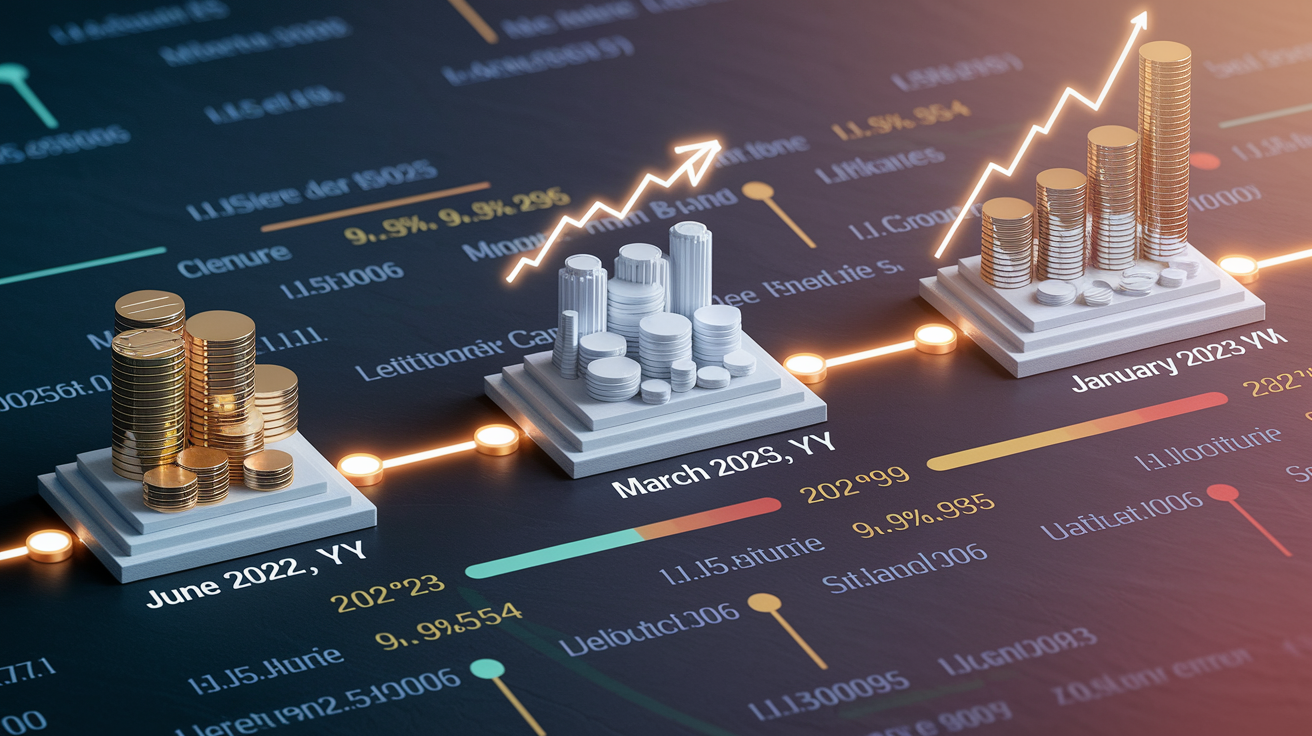
June 2022 stands as the clearest recent example of a CPI print reshaping the entire rate outlook. Headline CPI hit 9.1 percent year over year, the highest reading in decades and well above the roughly 8.8 percent consensus. Within hours, short term Treasury yields spiked, fed funds futures repriced to reflect a higher terminal rate, and the market began pricing multiple additional 75 basis point hikes instead of the 50 basis point increments previously expected. The 2 year yield jumped more than 20 basis points intraday, and by the end of the week the entire curve had shifted higher. That single print convinced markets the Fed would need to tighten far more than previously thought, and it marked the beginning of a sharp upward move in mortgage rates and corporate borrowing costs.
March 2023 provided a different kind of CPI lesson. How non CPI events can override or amplify inflation signals. On March 7, Fed Chair Powell testified to Congress and hinted at the possibility of a 50 basis point hike if inflation data continued to disappoint. Markets immediately repriced fed funds futures to assign high probability to a 50 basis point move at the March meeting. Days later, Silicon Valley Bank collapsed, triggering a broader financial stability concern. Even though CPI data had been firm, markets flipped expectations back to a 25 basis point hike (or even a pause) because traders judged the Fed would prioritize financial stability over incremental tightening. The five day range in the September 30 day fed funds futures contract reached 2.18 percentage points, a range that exceeded the entire fed funds trading range from 2010 to 2019.
January 2025 delivered another instructive surprise. Headline CPI rose 0.5 percent month over month, the largest gain since August 2023, and core CPI came in at 0.4 percent versus a 0.3 percent consensus. Markets had been pricing a September rate cut with reasonable confidence. After the print, the first cut expectation was pushed to December, and some strategists began modeling scenarios with no cuts until late 2025 or even a return to hikes if inflation persisted. The probability of holding rates steady at the next meeting jumped to 97.5 percent. Examples of rate expectation shifts:
June 2022: 9.1 percent y/y headline CPI, 20+ bps move in 2 year yield, terminal rate expectations lifted by 50+ bps over the following weeks. March 2023 testimony: Powell signals possible 50 bp hike, futures price 50 bp outcome with high probability. March 2023 SVB collapse: financial stress, market flips from 50 bp to 25 bp hike expectations within days, fed funds range swings 2.18 percentage points. January 2025: 0.5 percent m/m headline, 0.4 percent core, first cut expectation pushed from September to December, hold probability rises to 97.5 percent.
Implications of CPI Driven Rate Moves for Investors and Borrowers

For investors, CPI driven rate moves create both risk and opportunity across asset classes. Bond portfolios face immediate mark to market losses when yields spike on a hot CPI print, especially at the short end where duration is concentrated. Equity valuations compress when discount rates rise, and sectors like utilities, real estate investment trusts, and high growth technology tend to underperform because their cash flows are more sensitive to higher rates. Conversely, financials (especially banks) can benefit from a steeper curve and higher net interest margins. Credit spreads often widen after upside CPI surprises as corporate borrowers face higher refinancing costs and the risk of a policy mistake rises. Investors who maintain flexibility in duration and hold volatility hedges (such as options on Treasury futures or rate cap structures) can reduce drawdowns and position for the next move.
Borrowers see the most direct impact. Higher CPI increases the chance of higher borrowing costs across mortgages, auto loans, and corporate debt. When markets reprice rate expectations upward, mortgage rates adjust within days because they track the 10 year Treasury yield plus a spread. A 30 basis point move in the 10 year can translate into a similar move in the 30 year fixed mortgage rate, raising monthly payments and reducing affordability. Corporations planning bond issuance face the same dynamic. A hot CPI print can widen credit spreads and lift all in funding costs, sometimes enough to delay or cancel a planned deal. The higher for longer scenario that follows persistent CPI surprises means borrowers lose the refinancing relief they were counting on, and floating rate debt becomes more expensive as reference rates stay elevated. Positioning strategies in a CPI sensitive environment:
Duration management: shorten duration ahead of CPI releases if inflation risks are skewed to the upside, extend duration if soft prints are likely. Volatility hedges: use options on Treasury futures, rate caps, or swaptions to protect against large moves. Sector rotation in equities: tilt toward financials and away from rate sensitive sectors when CPI trends hot. Fixed vs floating mix for borrowers: lock in fixed rates before CPI if inflation momentum is building, stay floating if cuts are coming. Monitor breakevens and real yields: rising real yields signal Fed tightening beyond pure inflation, a bearish signal for risk assets.
Final Words
in the action we traced the chain: CPI release → inflation surprise → immediate repricing of rate bets. Core CPI and the size of the surprise steer short‑end yields hardest, while larger surprises ripple through the curve and breakevens.
Near term, watch core m/m, shelter dynamics, Fed funds futures, the 2‑year and 10‑year, and option‑implied vols. Scenario plan: base, upside, downside.
Knowing how CPI prints move interest rate expectations gives you a clear playbook to adjust duration and hedges. Stay ready — the next print will tell you what to do.
FAQ
Q: How does the CPI affect interest rates?
A: The CPI affects interest rates by signaling inflation surprises that reprice Fed policy odds: hotter-than-expected CPI raises chances of rate hikes and lifts short-term yields, while cooler prints push expectations toward cuts or pauses.
Q: Is it good when CPI goes up or down?
A: Whether higher or lower CPI is good depends on context: falling CPI eases rate pressure, helps bonds and consumers; rising CPI erodes real incomes, raises borrowing costs, and often prompts monetary tightening.
Q: Why does Trump want the interest rate lowered?
A: Trump wants interest rates lowered because lower rates typically boost growth, support stocks, and cut borrowing costs—politically and economically useful—though the Federal Reserve independently sets policy, not the president.
Q: Is 3% the new 2% inflation?
A: Saying 3 percent is the new 2 percent implies a persistently higher inflation regime; the Fed still targets 2 percent, so durable 3 percent inflation would lift neutral rates and borrowing costs, but evidence remains mixed.