

Markets don’t react to geopolitics for politics’ sake.
They react to how those events change risk sentiment.
When a skirmish, sanction, or surprise election shocks the system, investors reprice risk fast and move capital toward safety.
That risk-sentiment flip is the core transmission mechanism. It drives rapid repricing, supply-driven price shocks and policy responses, all amplified by positioning and algos.
Read on to see the asset patterns, likely scenarios, and three clear watchpoints that tell you when to trade or sit tight.
Core Mechanisms Connecting Geopolitical Events to Market Volatility

Geopolitical events hit markets through four main channels: uncertainty, supply disruption, policy reaction, and capital movement. When tensions spike, whether it’s armed conflict, diplomatic collapse, or a trade fight, the first thing that happens is a fast repricing of risk everywhere. Investors pull money out of anything that feels dangerous and pile into safe assets. Valuations compress, spreads blow out, all within hours or days. Russia invading Ukraine on February 24, 2022 immediately tanked European stocks and sent money flooding into Treasuries and gold as markets scrambled to reprice energy security and sovereign credit.
Supply shocks are the second big pathway. Geopolitical events that cut off trade routes, energy supplies, or key commodities hit corporate margins and inflation forecasts directly. The 2018 U.S.‑China tariff fight forced companies to rebuild entire manufacturing networks, raising costs and creating delays that lasted for years. Energy markets are hypersensitive. Conflicts in oil‑producing areas (Middle East, Russia) can push crude up 10 percent or more in days, feeding inflation and changing what everyone expects from central banks. Sanctions make it worse by choking off access to capital, technology, or raw materials, forcing companies to completely rethink how they source inputs and fund operations.
Policy responses and how markets are wired magnify geopolitical shocks. Central banks might shift monetary policy if inflation surges or growth stalls because of geopolitical stress. Governments roll out sanctions, tariffs, or tap strategic reserves to manage the damage. Meanwhile, algorithmic and high‑frequency trading systems scan news feeds and react to keywords like armed conflict, sanctions, regime change in milliseconds, making price swings bigger. The VIX often doubles during sharp geopolitical shocks, partly from real uncertainty, partly from machines amplifying the move.
The main transmission channels:
- Risk sentiment flips: investors shift from risk‑on to risk‑off, dumping equities and emerging‑market assets while buying government bonds and gold.
- Capital flows reverse: foreign institutions pull out of regions that look unstable, weakening currencies and draining liquidity.
- Commodity supply gets interrupted: conflicts or sanctions disrupt energy, food, or metals production, spiking prices and adding to inflation.
- Policy and regulation change: governments impose tariffs, export controls, or sanctions that redraw trade flows and force companies to adapt.
- Market structure effects: algorithmic trading and stop‑loss cascades amplify volatility when news‑driven selloffs start.
How Different Types of Geopolitical Events Influence Market Behavior

Not every geopolitical event moves markets the same way. The type of event (military conflict, trade war, election, diplomatic crisis) determines which asset classes move, which sectors win or lose, and how long the volatility lasts. Knowing these patterns helps you anticipate direction and size of market reactions.
Military Conflict
Armed conflicts produce instant volatility in energy and commodities, especially when they happen in or near major production zones. Russia invading Ukraine in February 2022 sent Brent crude from roughly $90 to over $120 per barrel in weeks as global markets repriced supply risk from one of the world’s largest energy exporters. Defense and cybersecurity stocks typically outperform during conflicts as governments ramp military spending. Airlines, tourism, and consumer discretionary names usually underperform. Safe‑haven assets (gold, Swiss francs, Treasuries) see heavy inflows as investors look for downside protection. If the conflict drags on, equity indices can stay volatile for months, and supply‑chain shifts may last years.
Trade Disputes and Sanctions
Trade wars and sanctions create targeted, sector‑specific volatility instead of broad market selloffs. The U.S.‑China tariff conflict from 2018 onward hit tech hardware, industrial machinery, and consumer goods companies with big China exposure. Apple and Tesla saw stock price swings as investors recalculated margin impacts from tariffs and potential supply disruptions. Sanctions on Russia in 2022 disrupted energy, metals, and agricultural commodity flows, forcing European manufacturers to hunt for alternative suppliers at higher costs. These events often unfold over quarters, producing rolling waves of volatility as each round of tariffs or sanctions gets announced and implemented. Currency markets react too. Sanctioned countries’ currencies typically weaken, while the imposing country’s currency may strengthen on safe‑haven demand.
Elections and Political Transitions
Elections bring policy uncertainty, which markets hate. Pre‑election volatility rises as investors game out scenarios: changes in tax policy, regulation, trade stance, or central bank appointments. India’s 2019 general election created weeks of uncertainty, then a sharp rally after the result when the incumbent government’s return signaled policy continuity. Unexpected election outcomes (Brexit on June 23, 2016) can trigger immediate currency crashes and equity selloffs. The British pound fell more than 8 percent against the dollar within hours of the referendum result. Elections in major economies affect global markets through policy expectations. A pro‑growth, pro‑business result typically supports equities. Populist or protectionist outcomes increase volatility.
Diplomatic Crises and Alliances
Diplomatic breakdowns and alliance shifts affect currencies, foreign direct investment, and regional equity markets. When the United States removed India from its Generalized System of Preferences in 2019, Indian textiles, chemicals, and engineering goods faced higher tariffs, pressuring those sectors. Realignments (new trade blocs or defense pacts) can create long‑term winners and losers. Countries joining sanctions coalitions see their currencies and sovereign bonds supported by alignment with major financial centers. Isolated nations face capital flight and credit downgrades. Diplomatic crises often produce smaller, more localized market impacts than wars or sanctions, but they set the stage for larger structural shifts if tensions escalate.
Asset‑Class‑Specific Reactions to Geopolitical Shocks
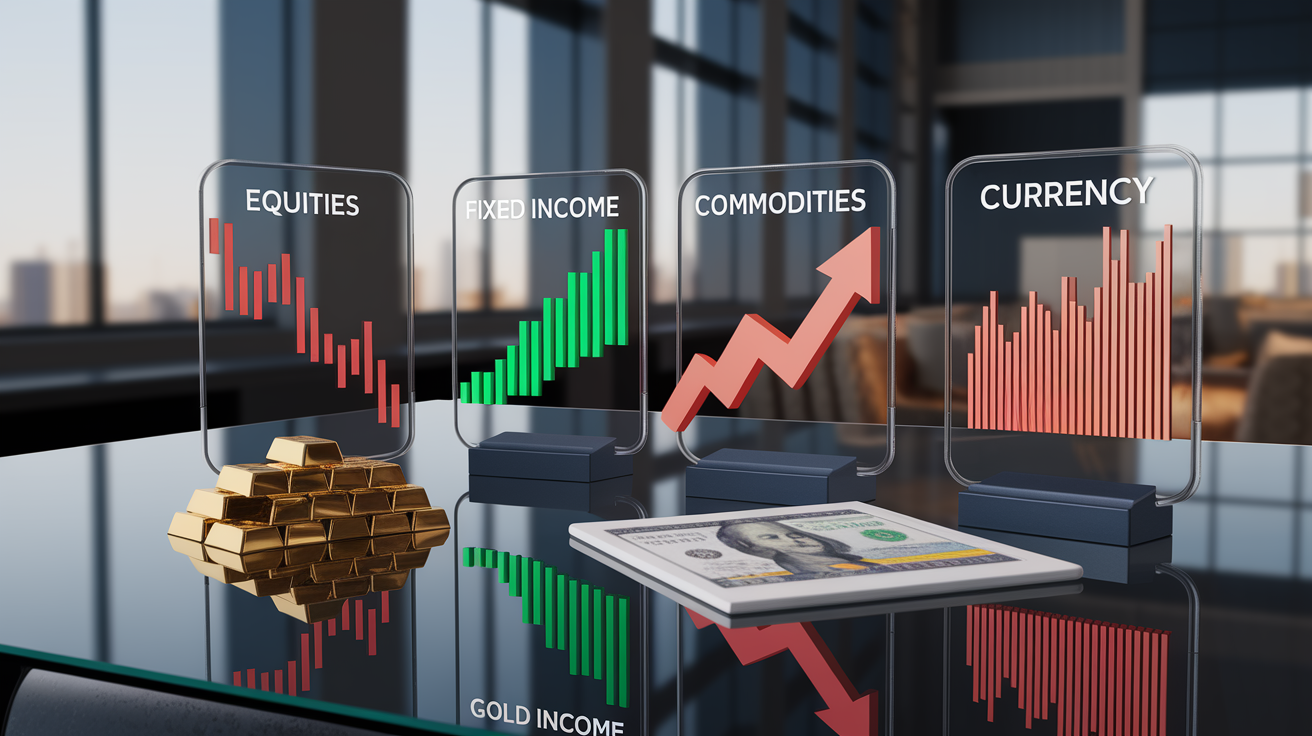
Asset classes respond to geopolitical shocks through different channels. Equities reprice earnings and discount rates, bonds reflect shifts in safe‑haven demand and policy expectations, commodities react to supply disruptions, and currencies move on capital flows and perceived national risk. The size and direction of each asset’s reaction depend on the type and severity of the event, the underlying economic cycle, and where markets were positioned going in.
| Asset Class | Typical Reaction | Example Scenario |
|---|---|---|
| Equities | Immediate decline, sector rotation; export‑dependent and cyclical stocks underperform, defense and staples outperform | Russia‑Ukraine war Feb 2022: European equities fell 5–10% in days; U.S. energy and defense stocks rallied |
| Fixed Income (Government Bonds) | Safe‑haven rally pushes yields down; credit spreads widen for riskier issuers | Brexit June 2016: U.K. gilt yields dropped sharply; emerging‑market bond yields widened |
| Commodities (Energy, Metals, Grains) | Price spikes on supply disruption fears; oil, natural gas, wheat most sensitive | Russia‑Ukraine war: Brent crude jumped from ~$90 to $120+; wheat prices surged on Black Sea export risk |
| Currencies | Reserve currencies (USD, CHF) strengthen; emerging‑market and conflict‑zone currencies weaken | 2022 Fed rate hikes + Ukraine conflict: USD index rose; Indian rupee and Turkish lira weakened |
| Safe Havens (Gold, Swiss Franc, JPY) | Strong inflows during risk‑off episodes; gold can gain 5–15% in acute shocks | COVID‑19 March 2020 and Russia‑Ukraine Feb 2022: gold rallied; Swiss franc and yen appreciated |
Equities see the most immediate volatility. Broad indices commonly drop 3–10 percent in the days after acute geopolitical shocks as investors reprice earnings risk and raise discount rates. Sectors directly exposed to the conflict zone or supply disruption (European industrials during the Ukraine war, U.S. tech during U.S.‑China tensions) suffer deeper declines. Defensive sectors (utilities, consumer staples, healthcare) and strategic beneficiaries (defense, cybersecurity, domestic energy producers) often outperform. If the shock hits when the economy is already weak, equity declines can extend into correction territory (more than 10 percent).
Fixed income markets split between safe havens and risk assets. High‑quality government bonds (Treasuries, German bunds, Japanese government bonds) rally as investors flee equities, pushing yields down. Credit spreads widen for corporate bonds, especially high‑yield issuers and those with exposure to the affected region. Emerging‑market sovereign bonds face dual pressure: capital flight and currency depreciation. Policy responses complicate the picture. If a geopolitical shock drives inflation (via energy or food prices), central banks may hike rates, counteracting the flight‑to‑quality effect.
Commodities react most directly to supply‑chain disruption. Energy markets are the primary channel. Conflicts in the Middle East, Russia, or major shipping lanes (Strait of Hormuz, Suez Canal) can spike oil and natural gas prices by double digits within days. Agricultural commodities follow a similar pattern when grain‑producing regions are disrupted. Metals (aluminum, nickel, palladium) spiked during the Russia‑Ukraine war because Russia is a major producer. These commodity price shocks feed into inflation, affecting central bank policy and broader asset allocation.
Currencies reflect both safe‑haven flows and fundamental economic damage. The U.S. dollar typically strengthens during global crises as investors seek liquidity and stability. The Swiss franc and Japanese yen also appreciate. Currencies of countries directly involved in the conflict, or heavily reliant on disrupted commodities, weaken sharply. Emerging‑market currencies face additional pressure from foreign capital outflows. Gold, often treated as a currency proxy, gains during acute risk‑off episodes, sometimes rallying 10 percent or more in weeks.
Historical Examples of Geopolitical Events Driving Market Volatility
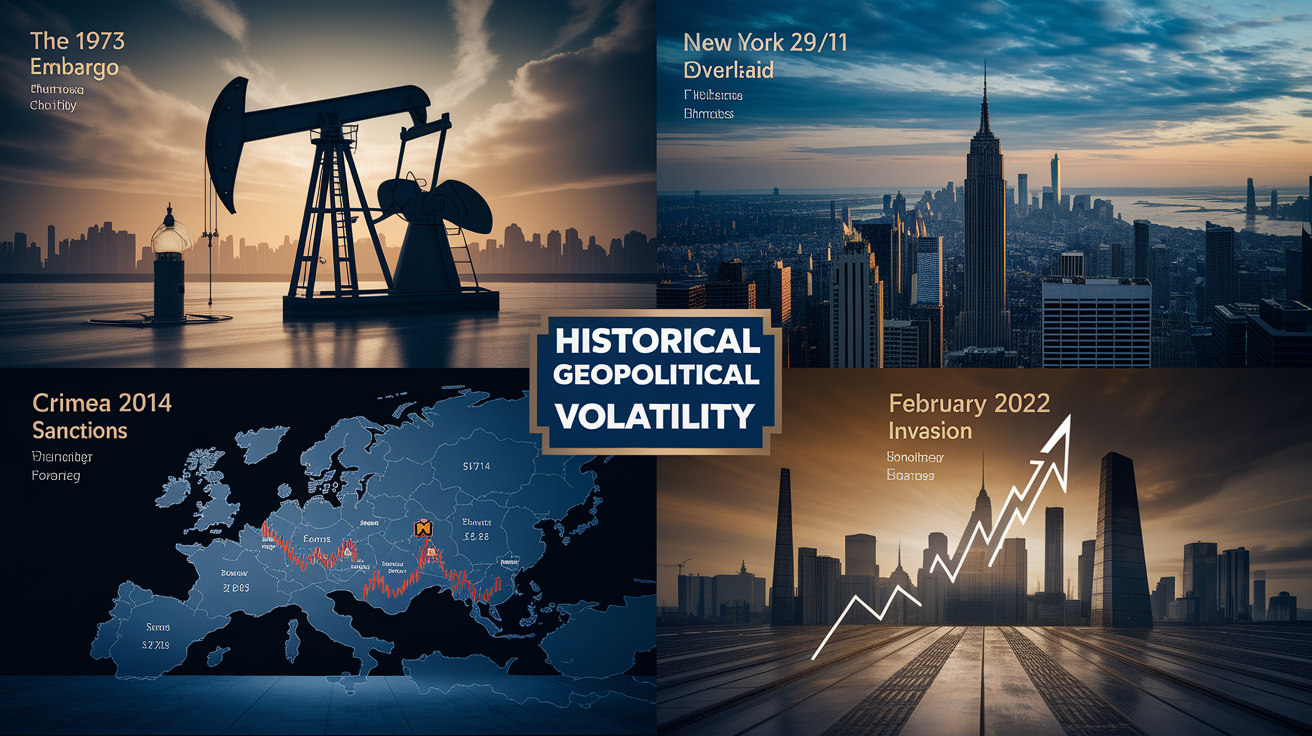
The 1973 oil embargo is the foundational case study in geopolitical market impact. In October 1973, OPEC members imposed an oil embargo on nations supporting Israel in the Yom Kippur War, targeting the United States and several Western European countries. Oil prices quadrupled from roughly $3 to $12 per barrel within months. U.S. equity markets, already under pressure from inflation, fell into a prolonged bear market. The S&P 500 declined more than 40 percent from peak to trough by 1974. Energy stocks initially rallied but broader economic damage from stagflation (high inflation, low growth) weighed on all sectors. The episode showed how geopolitical supply shocks in critical commodities can trigger multi‑year economic and market downturns, especially when the affected economy is structurally dependent on the disrupted resource.
The September 11, 2001 attacks on the United States produced immediate, severe market dislocation. U.S. equity markets closed for four trading days, the longest shutdown since the Great Depression. When they reopened on September 17, the S&P 500 fell 4.9 percent in a single day and declined more than 11 percent over the following week. Airlines, insurance, and travel‑related stocks collapsed. Airline stocks fell more than 40 percent in days. Safe‑haven assets rallied: gold rose, Treasury yields fell, and the dollar initially strengthened. The Federal Reserve cut rates aggressively and injected liquidity to stabilize markets. By early 2002, equity indices had largely recovered, but the attacks accelerated structural shifts in defense spending, cybersecurity investment, and global trade security protocols that reshaped markets for years.
Russia’s annexation of Crimea in March 2014 demonstrated how regional conflicts create targeted volatility. Russian equities and the ruble plunged. The MICEX index fell more than 10 percent in days, and the ruble weakened sharply against the dollar. Western sanctions on Russian energy and financial firms disrupted European energy markets and forced supply‑chain adjustments. European equities declined modestly, and Brent crude prices spiked on uncertainty about Russian oil flows. The episode was contained regionally. U.S. and Asian markets saw limited direct impact. But the 2014 crisis set precedents for the far larger sanctions and supply disruptions that followed Russia’s full‑scale invasion of Ukraine in 2022, when energy price shocks and capital flight were an order of magnitude larger.
The February 24, 2022 Russian invasion of Ukraine triggered the most acute geopolitical market shock since the 2008 financial crisis. European equity indices fell 5–10 percent in the first week. Brent crude oil surged from around $90 to over $120 per barrel, and natural gas prices in Europe spiked to record levels. The VIX volatility index doubled from the low teens to the mid‑30s. Safe‑haven flows into Treasuries, gold, and the dollar were immediate. Gold rallied toward $2,000 per ounce. Sanctions on Russian banks and the exclusion of major Russian institutions from the SWIFT payment system disrupted global financial flows. Emerging‑market equities and currencies weakened on risk‑off sentiment and concerns about commodity inflation. The conflict’s prolonged nature (still ongoing as of March 2026) reshaped energy markets, accelerated European defense spending, and forced multinational companies to write off Russian assets and reconfigure supply chains, producing rolling waves of volatility across multiple quarters.
Investor Psychology and Behavioral Responses During Geopolitical Tension

Geopolitical shocks trigger predictable behavioral patterns: fear‑driven selling, herding toward perceived safety, overreaction to headlines, and heightened sensitivity to subsequent news. When an unexpected conflict or diplomatic breakdown occurs, investors often sell first and assess fundamentals later, compressing valuations and creating liquidity voids. The initial selloff is frequently amplified by algorithmic trading systems that monitor news feeds for keywords like war, sanctions, or invasion and execute programmed risk‑reduction trades within milliseconds. This mechanical response can push indices down 3–5 percent or more in a single session, even when the event’s long‑term economic impact is unclear.
Herding behavior intensifies during geopolitical uncertainty. As risk‑off sentiment spreads, institutional and retail investors alike move capital into crowded safe‑haven trades (Treasuries, gold, Swiss francs), driving those assets to extreme valuations. Emerging‑market equities and high‑yield bonds see indiscriminate selling, regardless of individual country or issuer fundamentals. This collective flight to safety creates mispricings. High‑quality companies in unaffected regions often trade at discounts simply because they share an asset‑class label with riskier peers. Cognitive biases (recency bias, availability heuristic, loss aversion) lead investors to overweight recent headlines and underestimate the market’s historical resilience to geopolitical shocks.
Media amplification plays a central role in shaping sentiment. 24‑hour news cycles and social media accelerate the spread of worst‑case scenarios, often before verified details are available. Investors react to headlines rather than underlying data, producing volatility spikes that can reverse within days as facts clarify. The challenge is distinguishing genuine long‑term risks (structural supply disruptions, sustained policy shifts) from transient noise. Behavioral finance research shows that during geopolitical stress, investors systematically overestimate the probability of extreme outcomes and underestimate the economy’s adaptive capacity. This bias creates opportunities. Disciplined investors who maintain exposure to fundamentally sound assets during panic‑driven selloffs often capture significant gains when markets normalize. The key is separating the immediate emotional response from the medium‑term fundamental analysis, a skill that requires pre‑defined decision rules and stress‑tested portfolio frameworks.
Tools and Frameworks for Analyzing Geopolitical Risk
Investors and analysts use structured frameworks to evaluate how geopolitical events might affect portfolios and to identify actionable hedges or opportunities. Scenario analysis is the foundational tool: construct a base case (most likely outcome), an upside case (conflict de‑escalates or resolves quickly), and a downside case (escalation, broader contagion, prolonged disruption). For each scenario, map the expected impact on key asset classes (equities, bonds, commodities, currencies) and estimate portfolio profit‑and‑loss under each path. This exercise forces explicit assumptions about transmission channels (supply shocks, capital flows, policy responses) and highlights which positions are most vulnerable. Probability weighting each scenario produces an expected value that guides position sizing and hedge allocation.
Common tools and frameworks:
- Geopolitical risk indices: academic and institutional measures (such as those from the Federal Reserve or think tanks) that quantify the frequency and intensity of geopolitical news, providing a historical benchmark for current stress levels.
- Country‑risk models: systematic assessments of political stability, governance quality, economic resilience, and external vulnerabilities; used to rank emerging markets and guide capital allocation.
- Scenario planning and stress testing: building alternative futures (escalation vs. de‑escalation, contagion vs. containment) and modeling portfolio returns under each, often using Monte Carlo simulation or historical analogs.
- Options‑based hedging strategies: buying protective puts on equity indices or high‑beta sectors, or using volatility products (VIX futures, options) to offset downside risk during acute shocks.
- Monitoring real‑time indicators: tracking VIX, sovereign credit default swap spreads, FX moves (dollar index, emerging‑market currencies), commodity prices (oil, gold), and trade flow data (container throughput, shipping rates) to detect early signs of stress.
- Diversification stress tests: evaluating how portfolio correlations shift during geopolitical crises. Safe havens and risk assets typically become more negatively correlated, while within‑equity correlations rise, reducing diversification benefits when they’re most needed.
Final Words
In the action: we mapped the transmission channels: risk sentiment, capital flows, commodity supply shocks, and policy expectations, and showed how wars, sanctions, trade disputes, and elections move prices across equities, bonds, commodities, and currencies.
The case studies and behavioral section made the why concrete: when news spikes fear, markets herd and safe havens rally, while sector and country exposure determines the damage.
For investors, use scenario planning, watch clear indicators, and size flexibly. Track how geopolitical events translate into market volatility and treat volatility as a source of opportunity, not just risk.
FAQ
Q: What is geopolitical volatility?
A: Geopolitical volatility is market instability caused by political events—wars, sanctions, or elections—that alter risk perceptions, capital flows, or supply chains, often provoking rapid price moves and wider bid‑ask spreads.
Q: What is the relationship between geopolitical risks and stock market volatility? Can geopolitical events influence market sentiment and prices?
A: The relationship is that geopolitical risks change sentiment and prices by shifting growth expectations, risk premia, and capital flows, which can trigger equity sell‑offs, sector rotations, or safe‑haven rallies.
Q: What contributes to market volatility?
A: Market volatility is driven by new information, position flows, liquidity swings, macro shocks and events such as geopolitical conflicts, commodity supply disruptions, policy surprises, and changing investor sentiment.