


What if a small rise in the term premium can shave billions off tech valuations overnight?
When investors demand more yield to hold long Treasuries, 10-year yields climb even if the Fed stands pat.
That extra yield becomes the discount rate baked into every discounted cash flow (DCF) model.
Growth stocks get hit hardest because most of their cash shows up years from now.
So the simple thesis: rising term premium raises the hurdle rate, which shrinks the present value of distant profits and punishes high-multiple tech names.
Read on for the mechanics, historical episodes, and the levels to watch.
How Term Premium Influences Growth Stock Valuations

Term premium is the extra yield investors want for locking money into long-term Treasuries instead of rolling over short-term bills. When it rises, 10-year yields jump even if the Fed’s near-term path stays put. That extra yield flows straight into the discount rates people use to value stocks. Growth companies get hit hardest because most of their earnings sit years down the road. Present value of a distant cash flow shrinks faster than something you’ll collect next quarter when you crank up the discount rate.
Simple math makes it clear. A dollar arriving in 10 years, discounted at 2 percent, is worth about 82 cents today. Bump the rate to 3 percent and that same dollar drops to 74 cents. Nearly 9 percent gone for a single percentage point move. Growth stocks pack most of their value into years well past the next earnings call, so even small upticks in long yields can shave billions off market caps. Value stocks pull more worth from near-term dividends and operating cash, so they don’t feel the same pain when the long end of the curve moves.
History shows the pattern over and over. During the 2013 taper tantrum, term premium widened and 10-year yields shot up roughly 100 basis points in a few months. High-multiple tech and biotech names underperformed defensive value by double digits. The 2021–2022 tightening cycle was the same story. Real yields rose, term premium expanded from deeply negative levels, and growth indices dropped 20 to 30 percent while energy, financials, and other value plays held steady or even posted gains. The mechanics don’t change. Longer-duration equity claims lose more when bond markets reprice the cost of waiting.
Mechanics of the Term Premium and Long-Term Treasury Yields
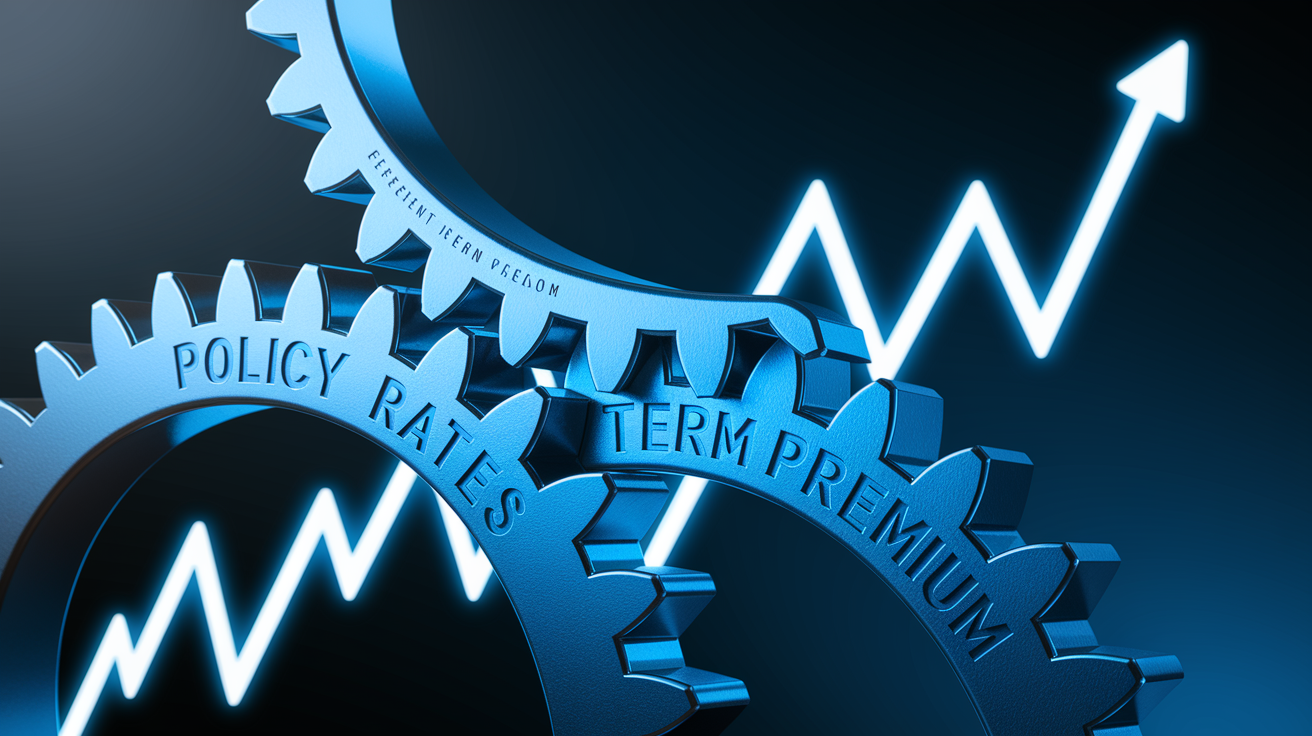
Long Treasury yields have two pieces: expected short-term policy rates over the bond’s life, and the term premium. The first reflects what investors think the Fed will do. The second compensates for uncertainty. Will inflation surprise? Will deficits balloon? Will geopolitical shocks rattle safe-haven flows?
When inflation uncertainty climbs or Treasury borrowing swells, bond investors demand a fatter premium to lock in funds for a decade. That extra yield has nothing to do with the next few Fed meetings. It’s a buffer for the unknowns between now and maturity. If the premium expands from near zero to 50 or 75 basis points, the 10-year yield climbs by the same amount even if the forecast for overnight rates doesn’t budge. The additional yield flows into every discounted cash flow model, lifting the hurdle for equity valuations across the board.
Supply and demand drive it too. Big fiscal packages or quantitative tightening that shrinks the Fed’s balance sheet push more duration into private hands, forcing investors to demand higher pay. Geopolitical stress can swing the premium either way. Flight to safety compresses it, concerns about debt sustainability or currency risk widen it. Term premium isn’t static. It’s a live reflection of macro risk sentiment, and when it moves, long yields follow, dragging discount rates higher and pressuring the present value of growth stock earnings that live years out on the calendar.
Discounted Cash Flow Sensitivity to Higher Long-Term Yields

Equity analysts forecast future free cash flows and divide each by (1 + discount rate) raised to the power of the number of years ahead. The discount rate usually starts with the risk-free rate, often the 10-year Treasury, then adds an equity risk premium and maybe a company-specific adjustment. When term premium pushes the 10-year yield from 3 percent to 4 percent, that entire basis point increase feeds into the denominator for every projection year. For cash arriving in year one or two, the impact is modest. For cash in years eight, nine, or ten, the present value haircut is far steeper because compounding amplifies over time.
Growth companies often show minimal or negative earnings early on as they plow revenue into product development, market expansion, or capacity. Analysts pencil in breakeven or light profitability for the first few periods, then model accelerating cash generation in the out years once scale kicks in. That back-loaded profile means the bulk of enterprise value sits beyond year five. When discount rates rise, those distant cash flows lose proportionally more value than the near-term trickle, compressing the sum-of-parts valuation and often triggering sharp price moves.
Core discount rate components investors track:
- Risk-free rate, anchored by the 10-year Treasury and directly sensitive to term premium moves.
- Equity risk premium, which may widen or narrow with volatility but tends to stay relatively stable short term.
- Beta or company-specific risk adjustment, reflecting how the stock’s returns correlate with broader markets.
- Growth duration penalty, an implicit add-on some models apply when cash flows are heavily concentrated in distant periods, raising the effective hurdle to account for forecast uncertainty.
Each percentage point rise in the composite discount rate can cut a growth stock’s fair value by 10 to 15 percent or more, depending on how far out the bulk of cash flows lie and how confident the market feels about those projections.
Historical Episodes of Rising Term Premium and Market Reactions

In 1994, the Fed surprised markets with a series of rate hikes that pushed policy rates up sharply. Bond investors hadn’t priced in the speed or size of tightening, so term premium widened as they demanded extra yield to hedge inflation and policy uncertainty. Long Treasury yields climbed roughly 200 basis points over the year. Growth stocks, particularly tech and telecom names that had strong runs in the early 1990s, suffered double-digit declines in the second and third quarters. Value-oriented financials and industrials did better because their earnings were more immediate and dividend yields provided a cushion against rising rates.
The 2013 taper tantrum is another clear case. In May that year, Fed Chair Ben Bernanke hinted the central bank would start scaling back bond purchases. Term premium, which had been compressed by quantitative easing, began to rise as investors anticipated reduced Fed demand for duration. Ten-year yields jumped from around 1.6 percent in early May to nearly 3.0 percent by year end. High-growth sectors like biotech, social media, and cloud software underperformed defensive value plays by 15 to 20 percent over the summer. The mechanism was textbook. Higher long yields meant higher discount rates, and stocks whose valuations rested on earnings five or ten years out took the largest present value hits.
In late 2018, term premium widened again as the Fed continued balance sheet runoff and markets worried about the pace of rate normalization. Ten-year yields briefly touched 3.25 percent in October before risk-off sentiment and a dovish policy pivot brought them back down. During that October to December window, the tech-heavy Nasdaq fell more than 17 percent peak to trough, while energy and utilities held relatively steady. Each episode reinforces the same pattern. When term premium expands and long yields rise, growth stocks with back-loaded cash flows lose more value than their value peers.
| Year | Term Premium Change | Growth Stock Reaction | Value Stock Reaction |
|---|---|---|---|
| 1994 | +~100 bps | Tech/telecom down 10–15% mid-year | Financials/industrials outperformed |
| 2013 | +~75 bps | Biotech/cloud software lagged 15–20% | Defensive value held steady |
| 2018 Q4 | +~50 bps | Nasdaq fell 17% peak-to-trough | Energy/utilities relatively stable |
Comparing Growth and Value Performance During Term Premium Increases

Growth stocks behave like long-duration bonds in equity form. Their returns are super sensitive to discount rate changes because most of their value comes from cash flows arriving many years from now. Value stocks generate more return through current dividends, near-term earnings, and asset values that are less exposed to shifts in the far end of the yield curve. When term premium rises and long yields climb, the performance gap can be dramatic.
Key differences in rate sensitivity:
- Cash flow timing: Growth companies often show minimal free cash in years one through three, with the bulk arriving in years five through ten. Value firms typically deliver steady or growing cash today.
- Leverage and refinancing risk: Growth stocks frequently carry higher debt-to-equity ratios to fund expansion, making them more vulnerable to rising interest expense when long-term borrowing costs increase.
- Dividend yield cushion: Value stocks often pay meaningful dividends, providing a partial offset to price declines. Growth stocks reinvest earnings and offer little to no current income.
- Earnings visibility: Value companies tend to operate in mature industries with more predictable cash flows, reducing the discount applied to future earnings. Growth firms face higher forecast uncertainty, which compounds the impact of a higher discount rate.
- Market sentiment and positioning: When term premium widens, momentum and growth-chasing funds often de-risk quickly, amplifying the selloff in high-multiple names and creating relative outperformance for unloved value stocks.
The result is a pattern that repeats across cycles. In environments where term premium expands, whether from inflation concerns, fiscal uncertainty, or quantitative tightening, value indices routinely outperform growth by 500 to 1,000 basis points or more over six to twelve month windows. The relationship isn’t mechanical day to day, but over quarters the correlation between rising long yields and growth underperformance is strong and well documented.
Portfolio Strategies for Navigating Rising Term Premiums

Investors facing a rising term premium environment can take several concrete steps to reduce portfolio duration risk and position for a shift in factor leadership. These strategies balance the need to capture equity upside with the reality that higher long yields weigh on growth valuations.
First, tilt equity allocations toward quality value and dividend growers. Companies with stable earnings, low leverage, and current cash distributions are less sensitive to discount rate moves. Financials, utilities, and consumer staples often fit this profile and can outperform when term premium widens.
Second, shorten fixed income duration by rotating out of long-term Treasuries and into shorter-dated bills, floating-rate notes, or investment-grade corporate bonds with maturities under five years. This limits mark-to-market losses if yields continue to rise and locks in higher reinvestment rates as short-term paper rolls over.
Third, increase exposure to real assets and inflation-protected securities. TIPS adjust principal for inflation, providing a hedge if rising term premium is driven by inflation uncertainty. Real estate, commodities, and infrastructure investments can also benefit from pricing power in an inflationary environment.
Fourth, use interest rate hedges or options to protect concentrated growth positions. Treasury futures, interest rate swaps, or put spreads on growth-heavy indices can cap downside if a spike in yields triggers a sharp selloff in high-duration equities.
The key is to monitor term premium itself. Daily data are available from the New York Fed and Bloomberg. Watch for inflection points. A stable or declining premium suggests long yields are driven primarily by policy rate expectations, making growth stocks less vulnerable. A rising premium signals bond market repricing of uncertainty, and that’s when reducing equity duration and diversifying into value, shorter-duration fixed income, and real assets tends to pay off.
Final Words
In the action, we showed that a higher term premium pushes long-term yields up, lifting discount rates and trimming present value for distant cash flows, exactly why growth stocks feel it hardest.
We covered the mechanics behind term premium, DCF sensitivity, historical episodes where growth lagged, and clear comparisons with value.
The impact of rising term premium on growth stocks is straightforward: reduce duration risk, tilt allocations, or hedge rates. Do that and you can protect gains while staying positioned for eventual re-rating.
FAQ
Q: What happens when term premium increases?
A: When the term premium increases, long‑term Treasury yields and discount rates rise, lowering present values of future cash flows; growth stocks are hit hardest because their earnings are farther out.
Q: What is the 7% rule in stock trading?
A: The 7 percent rule in stock trading is a simple risk guideline: exit or reassess a position after about a 7 percent move to limit losses or lock in gains quickly.
Q: Who owns 88% of the stock market?
A: The claim that 88 percent of the stock market is owned refers to combined holdings by institutional investors and the wealthiest households—mutual funds, pensions, and ETFs hold the bulk.
Q: What are the two worst months for stocks?
A: The two worst months historically for stocks are September and October, with September showing the largest average declines and October adding volatility and occasional sharp selloffs.