


What if GDP, inflation, and the US dollar tell you oil’s next move before barrels actually change hands?
They often do, because financial markets price expectations faster than tankers or pipelines can.
This post exposes the handful of macro indicators that reliably lead oil prices—what they signal, how fast they act, and why that matters for positioning.
You’ll get a short, usable watchlist: immediate triggers (inventories, OPEC), near‑term movers (currency, real yields), and medium‑term demand gauges (PMI, GDP).
Read on to stop reacting and start anticipating.
Key Macro Indicators That Most Reliably Predict Oil Price Moves

Oil prices don’t just react to what’s happening in the physical market. They’re already moving on shifts in global growth expectations, currency swings, inventory flows, and central bank decisions before you ever see the actual supply or demand change show up at the well or the pump.
The best forecasting indicators share three things: they move fast, you can measure them clearly, and they’ve worked across multiple oil cycles. Manufacturing PMI readings, the US dollar, crude inventory reports, real yields, and OPEC+ spare capacity each give you different signals with different timing. Global manufacturing PMI dropping below 50 usually means oil weakness within three months. When Brent fell from around $115 in June 2014 to about $45 by January 2015, global PMI had been weakening through the second half of 2014. A one percent move up in the dollar tends to knock oil down 0.7 to one percent within days or weeks. Weekly US crude inventory builds above ten million barrels usually hit prices within days to two weeks. Big real yield increases during 2022—100 basis points or more—lined up with oil weakness over one to three months.
If you’re building a monitoring process, rank indicators by how fast they react and how reliable they are, then layer them by horizon. Immediate signals (hours to days) come from OPEC+ announcements and inventory surprises. Short term signals (days to four weeks) come from currency and yield moves. Medium term signals (one to three months) come from PMI trends and employment data. You don’t need to track every series. Focus on the handful that consistently lead prices with enough time to actually position.
Global and regional manufacturing PMI: Values above 50 signal expansion and rising oil demand. Sustained readings below 50 warn of contraction and downward price pressure within zero to three months.
US dollar strength (DXY): A one percent USD appreciation historically comes with roughly 0.7 to one percent oil decline over days to weeks, acting as a near immediate financial headwind.
Weekly US crude inventories and OECD commercial stocks: Builds exceeding ten million barrels per week or sustained four week builds above twenty million barrels generate bearish signals within days to two weeks.
Real yields and Fed policy shifts: Major real yield increases (100 basis points or more) reduce commodity demand expectations and correlate with oil weakness over one to three months.
OPEC+ production decisions and spare capacity: When spare capacity falls below roughly three percent of global demand or the group announces cuts of one percent or more of world consumption, prices typically spike within hours to weeks.
Demand‑Side Macro Indicators and Their Power to Anticipate Oil Price Direction

Demand side macro indicators act like the economy’s early warning system for oil markets. GDP growth, industrial production, and manufacturing activity translate directly into refined product consumption, freight volumes, and petrochemical feedstock use. Because these indicators reflect real economic activity before it fully shows up in spot crude balances, they offer predictive windows from immediate (PMI flash releases) to three to nine months (IMF GDP forecast revisions).
Global manufacturing PMI weakening through the second half of 2014 came before Brent’s collapse from about $115 per barrel in June 2014 to around $45 by January 2015. That’s a 61 percent drop over seven months driven by faltering demand expectations even as shale supply surged.
China’s economic data carries outsized weight because the country accounts for roughly 15 percent of global oil demand and most of marginal demand growth over the past two decades. Flash PMI readings from China’s National Bureau of Statistics and Caixin surveys, monthly industrial production prints, and refinery throughput reports move oil prices within days when they surprise consensus. A weak Chinese PMI print below 50 for two consecutive months, combined with falling steel output or slowing vehicle sales, has historically signaled downward oil price pressure within one to three months.
World industrial production indices improve Brent price forecasts across multiple horizons by capturing synchronized manufacturing cycles in major economies. That gives you a cleaner signal than relying on any single country’s data.
The 2008 financial crisis showed just how fast and how far demand driven oil collapses can go when macro indicators turn sharply negative. WTI peaked at $147.27 on July 11, 2008, then plunged roughly 77 percent to about $33 by December 2008 as global PMI readings collapsed, credit markets froze, and industrial activity contracted worldwide. The demand destruction was visible in manufacturing surveys and GDP revisions months before inventories fully reflected the shift. Traders who monitored leading indicators had time to adjust positions as the cycle turned.
Employment & Consumption Indicators
Payroll strength and consumer spending measures feed into gasoline, diesel, and jet fuel demand, creating a one to three month transmission channel from labor markets to crude prices. Strong US nonfarm payroll prints (particularly sustained monthly gains above 200,000) support oil demand expectations by signaling rising incomes, vehicle miles traveled, and discretionary consumption. The effect shows up within zero to two months as higher employment translates into commuting patterns, air travel, and goods movement that lift refined product crack spreads and pull crude higher.
Consumer confidence indices and retail sales data add context by revealing whether employment gains convert into actual spending. A divergence (strong payrolls but weak confidence or falling retail sales) warns that demand may not follow, reducing the bullish oil signal from employment alone. Tracking both the headline payroll number and the details (average hourly earnings, labor force participation, services vs goods employment) sharpens the demand forecast, especially when combined with weekly gasoline demand estimates and vehicle miles traveled data that offer near real time consumption proxies.
Financial and Monetary Indicators That Move Oil Prices Ahead of Fundamentals

Currency and interest rate channels often move oil prices faster than physical supply demand shifts because they operate through expectations, positioning, and cross asset flows.
A one percent appreciation in the US dollar historically aligns with about a 0.7 to one percent decline in oil prices. That relationship is driven by the dollar’s role as the invoicing currency for crude and the mechanical effect on non US buyers’ purchasing power. The reaction window is short (days to weeks) because currency markets price in macro news instantly and commodity traders adjust positions in response.
Federal Reserve hiking cycles, like the 2022 tightening that lifted the fed funds rate by more than 400 basis points, weakened oil within one to three months as higher real yields raised discount rates for commodities and strengthened the dollar. Real yields particularly matter because they capture the opportunity cost of holding non yielding assets like oil. Large real yield increases (100 basis points or more) reduce demand expectations and shift futures curves into contango as financial conditions tighten.
Inflation data and central bank policy shifts create secondary but powerful effects. Rising headline CPI can temporarily lift oil as markets price in more demand driven growth, but sustained inflation that prompts aggressive rate hikes eventually reverses into oil weakness as tighter financial conditions slow activity. The 2022 experience illustrated this sequence: oil rallied early in the year on reopening demand and geopolitical risk, then fell into the second half as the Fed’s response to high inflation raised real yields and strengthened the dollar.
Financial conditions indices (aggregating credit spreads, equity volatility, funding costs, and term premia) significantly improve oil price forecasts in factor augmented models by summarizing the liquidity and risk environment that governs speculative positioning and corporate hedging behavior.
US dollar index (DXY): Track daily. Moves of two percent or more in a week often correlate with oil swings of 1.5 to two percent within days to two weeks.
Ten year real yields: Monitor daily. Increases of 50 basis points or more over a few weeks signal tighter financial conditions and potential oil weakness within one to three months.
Federal Reserve policy announcements and dot plots: Immediate reaction within hours. Larger directional effects unfold over one to three months as rate expectations adjust demand forecasts.
Inflation prints (CPI, PCE): Monthly releases. Upside surprises can lift oil short term if they signal demand strength, but sustained high inflation that triggers rate hikes becomes bearish over one to three months.
Supply‑Side Macro Signals That Predict Oil Tightness or Gluts

Inventory levels and futures curve structure offer the most immediate supply side forecasting tools because they reflect real time physical balances and near term storage capacity.
Weekly US crude inventory reports from the Energy Information Administration move prices within minutes of release, with builds above ten million barrels typically exerting downward pressure over the following days to two weeks. Sustained OECD inventory builds exceeding twenty million barrels over four weeks signal structural oversupply and often mark local price tops, as markets anticipate further selling pressure or production cuts.
The futures curve itself acts as a continuous supply tightness gauge: backwardation of three to five dollars per barrel or more between the front month and three month contract signals physical tightness and supports prompt prices, while deep contango warns of oversupply and downward pressure on near term futures.
OPEC+ production decisions and spare capacity estimates shape medium term supply expectations and generate immediate price reactions. When the group’s spare capacity falls below roughly three percent of global oil demand (about three million barrels per day), the market prices in heightened vulnerability to disruptions, lifting volatility and supporting prices. Announced production cuts of one percent or more of global demand, such as the coordinated Saudi Russia reductions in 2023, typically generate price spikes within hours to days as traders adjust forward supply curves.
Compliance and cheating matter. OPEC+ quotas only tighten markets if members actually cut, so monitoring tanker flows, satellite imagery of loading terminals, and official secondary source estimates provides early warnings when announced cuts fail to materialize.
Rig counts, capital discipline, and geopolitical sanctions operate on longer horizons but with predictable lead times. Large declines in the Baker Hughes US rig count (order of magnitude falls of several hundred rigs) preceded supply tightening with a lag of six to twelve months after the 2016 bottom, as reduced drilling eventually translated into lower production. Geopolitical shocks such as Russia’s invasion of Ukraine on February 24, 2022, pushed Brent to about $139 per barrel by March 7, 2022, demonstrating that sudden supply line threats or sanctions create immediate price spikes. The reaction speed depends on the perceived permanence of the disruption: temporary outages (refinery fires, weather) lift prices for days to weeks, while structural shifts (long term sanctions, multi year production declines) support higher prices for months to years.
Physical Stockpiles & Storage Constraints
Storage capacity becomes the binding constraint during extreme oversupply, capable of creating price moves that defy traditional supply demand logic.
The April 2020 collapse of WTI’s front month contract to negative $37.63 on April 20, 2020, occurred because physical storage at Cushing, Oklahoma (the delivery point for NYMEX WTI futures) approached operational limits just as the May contract neared expiry. Holders of long futures positions faced the impossible choice of taking physical delivery into non existent storage or paying someone to take the contracts off their hands. The result was a historic anomaly where oil sellers paid buyers, a move that had nothing to do with long term supply demand fundamentals and everything to do with a short term physical bottleneck.
Storage constraints act as amplifiers during supply gluts. When global commercial crude stocks rise faster than available tank capacity, the market shifts into steep contango to incentivize storage, but if capacity fills entirely, prompt prices can collapse as producers and traders scramble to offload barrels.
Monitoring global storage utilization (particularly at key hubs like Cushing, the US Gulf Coast, Rotterdam, and Singapore) provides early warning of these extremes. OECD days of forward cover (total stocks divided by average daily demand) offers a smoother longer term gauge: readings above 65 days historically signal oversupply and downward price pressure, while readings below 55 days indicate tightness and upside risk.
Composite and Factor‑Based Macro Indicators for Forecasting Oil Prices

Single macro indicators carry noise and regime dependent reliability. Composite indicators built from multiple series increase signal strength and forecast accuracy by canceling out idiosyncratic variation.
Factor augmented autoregressive and vector autoregressive models use dimensionality reduction techniques (primarily principal component analysis) to compress large datasets into a handful of orthogonal factors that capture the bulk of variation across dozens or hundreds of macro series. One study employed a global dataset of roughly 200 macroeconomic time series across the 33 largest economies to forecast oil, gas, and coal prices at quarterly horizons. Another constructed a composite indicator from 16 variables spanning eight categories: activity measures, non energy commodities (for example copper prices), financial conditions, expectations surveys, uncertainty indices, transportation proxies, weather indicators, and energy supply and distribution metrics. The first principal component of this 16 variable set outperformed many single indicator benchmarks, particularly at horizons beyond one quarter.
Non energy commodity factors (typically the first principal component of 23 industrial and agricultural commodity prices) improve oil forecasts over both short and long horizons by capturing global demand and liquidity conditions that affect all commodities. A PCA extracted shipping cost factor, which aggregates freight rates and vessel utilization across multiple routes, outperformed the single series Kilian shipping cost proxy in several empirical tests for Brent and refiner acquisition costs.
Financial conditions factors, built from exchange rates, equity returns, credit spreads, and volatility indices, add predictive power by summarizing the liquidity and risk environment that governs commodity positioning. The practical benefit is parsimony: instead of tracking 200 raw series, traders can monitor five to eight composite factors (activity, commodities, shipping, finance, uncertainty, expectations, energy supply, weather) to capture most of the macro signal relevant to oil.
| Indicator Type | Data Inputs | Typical Forecast Horizon |
|---|---|---|
| Composite macro factor | 16 variables across 8 categories (activity, commodities, finance, expectations, uncertainty, transport, weather, energy supply); first principal component | 1–4 quarters; improved accuracy vs single variable models at medium horizons |
| Non energy commodity PC | First principal component of 23 industrial and agricultural commodity prices | Short (1 quarter) and long (4+ quarters); competitive or superior to shipping proxies |
| Financial conditions factor | Exchange rates, equity returns, credit spreads, VIX, term premia; PCA or index aggregation | Days to weeks for immediate moves; 1–3 months for demand channel effects via tighter/looser conditions |
Historical Case Studies Showing How Macro Indicators Led Oil Price Moves
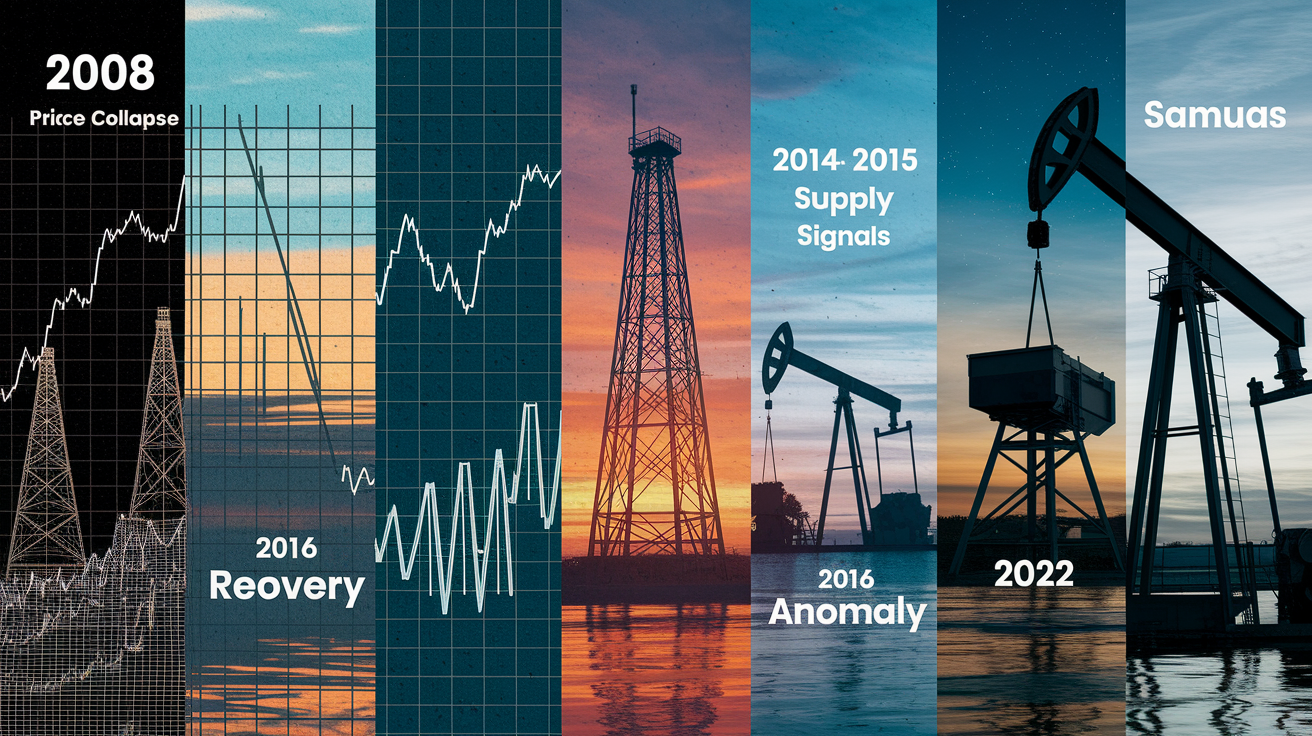
The 2008 financial crisis remains the textbook example of demand driven oil collapse signaled by leading macro indicators. WTI crude peaked at $147.27 per barrel on July 11, 2008, reflecting tight supply, strong emerging market demand, and speculative positioning. Within five months, WTI had plunged roughly 77 percent to around $33 by December 2008 as the global financial system froze, manufacturing PMI readings collapsed below 40 in major economies, and industrial production contracted at rates not seen since the 1930s.
The macro indicators (credit spreads widening, equity markets crashing, PMI falling, unemployment spiking) all turned sharply negative months before physical oil inventories fully reflected the demand destruction. Traders who monitored these signals got advance warning of the coming price collapse.
The 2014–2015 oil bear market demonstrated how supply side macro signals (rig counts, production growth) combined with weakening demand indicators (slowing China PMI, eurozone stagnation) to forecast a prolonged downturn. Brent crude fell from about $115 per barrel in June 2014 to around $45 by January 2015. That’s a 61 percent decline over seven months. The move began as US shale production surged past nine million barrels per day, OECD inventories built steadily, and global manufacturing PMI weakened through the second half of 2014. OPEC’s decision in November 2014 not to cut production despite rising inventories confirmed the bearish supply outlook, and the futures curve shifted into contango as physical storage filled. Traders watching rig count growth, inventory trends, and PMI momentum had clear signals that the market was oversupplied and demand growth was slowing, even before prices fell to their eventual lows.
The 2016 oil market bottom and subsequent recovery illustrated how lagging supply indicators (rig counts, capex cuts) eventually reverse into bullish signals with six to twelve month lead times. WTI bottomed near $26 per barrel in February 2016 after sustained inventory builds and weak global PMI, but the seeds of recovery were already visible: the Baker Hughes US rig count had fallen from over 1,600 in late 2014 to under 400 by mid 2016, signaling that production growth would soon slow. OPEC and Russia began coordinating informal production restraint, and Chinese stimulus measures supported industrial activity. By late 2016, inventories stopped building, the futures curve shifted back into backwardation, and prices recovered toward the $50–60 range. The macro signals (rig count declines, PMI stabilization, inventory draws) all turned before the price bottom, rewarding those who tracked supply response indicators with predictable lag structures.
April 2020’s negative WTI settlement at –$37.63 on April 20, 2020, was an extreme outlier driven by storage saturation rather than traditional macro indicators, but it still validated the importance of monitoring physical constraints and term structure signals. The COVID-19 demand collapse had already pushed oil lower through March 2020, with lockdowns cratering transportation fuel use and inventories building at record rates. As the May WTI contract approached expiry, storage capacity at Cushing neared operational limits, and holders of long futures positions had no way to take or store physical delivery. The front month contract collapsed into negative territory while later dated contracts remained positive, creating a historic contango that reflected the storage bottleneck rather than long term fundamentals. Macro indicators (collapsing PMI, unprecedented unemployment claims, mobility data showing near zero traffic) had signaled the demand shock weeks earlier, but the storage crisis required monitoring inventory levels, tank utilization, and futures spreads to anticipate the expiry day chaos.
2008 crisis: Leading macro indicators (PMI, credit spreads, equity crashes) turned months before the full physical demand collapse appeared in inventories. Reaction window was one to three months from macro signal to price bottom.
2014–2015 supply glut: Rig count growth, inventory builds, and weakening global PMI all signaled oversupply and falling demand. Futures curve shifted into contango as the signals accumulated over several months.
2016 recovery: Rig count declines of over 1,200 units from peak to trough preceded production slowdowns and price stabilization with a six to twelve month lag.
2020 negative prices: Extreme storage constraints and expiry mechanics created an anomaly. Macro signals (lockdown PMI, mobility collapse) forecasted demand destruction weeks earlier, but physical bottlenecks required monitoring storage utilization and term structure.
2022 Russia–Ukraine shock: Geopolitical macro signal (invasion on February 24, 2022) pushed Brent to about $139 by March 7, 2022. Subsequent easing into the $70–90 range through 2022–2023 reflected demand concerns (recession fears, central bank tightening) and alternative supply responses.
How To Build a Monitoring Dashboard of the Most Important Oil‑Forecasting Macro Indicators

A practical oil forecasting dashboard prioritizes high signal indicators organized by update frequency and reaction speed, allowing you to distinguish immediate risks (hours to days) from medium term trends (weeks to months).
Daily monitoring should cover the US dollar index, ten year nominal and real Treasury yields, front month and forward crude futures prices, and the term structure (specifically the one month, three month, six month, and twelve month spreads that reveal backwardation or contango). OPEC and International Energy Agency headlines, major central bank speeches, and real time tanker tracking via AIS data feeds provide event driven signals that can move prices within hours. Setting alerts for DXY moves exceeding plus or minus two percent in a week, real yield changes above 50 basis points, or futures curve shifts into backwardation or contango greater than three dollars per barrel ensures that critical financial and term structure signals trigger immediate review.
Weekly and monthly data releases require scheduled monitoring tied to publication calendars. The EIA’s Weekly Petroleum Status Report, released every Wednesday at 10:30 AM Eastern, reports US crude inventory changes. Builds or draws of ten million barrels or more in a single week warrant immediate attention and often move prices within minutes. Baker Hughes publishes the North American rig count every Friday, offering a lagging but directionally important supply signal with six to twelve month lead times.
Monthly releases (global, US, and China manufacturing and services PMI usually first few days of the month, US nonfarm payrolls first Friday, Consumer Price Index and Producer Price Index mid month, and IMF or World Bank quarterly growth revisions) should be tracked against consensus expectations, with surprises of 0.5 percentage points or more in GDP forecasts or two points or more in PMI triggering scenario updates.
Track daily: Brent and WTI spot and front month futures prices, DXY, ten year nominal and real yields, futures curve spreads (one/three/six/twelve months), OPEC+ and IEA news flow, and major tanker routes via AIS.
Track weekly: EIA Weekly Petroleum Status Report (focus on crude stock changes), Baker Hughes rig count, and any OPEC+ Joint Ministerial Monitoring Committee updates.
Track monthly: Global, US, and China manufacturing and services PMI, US nonfarm payrolls, CPI and PPI, retail sales, and preliminary global refined product demand estimates from consultancies.
Track quarterly: OPEC Monthly Oil Market Report, IEA Oil Market Report (inventory levels, demand forecasts, supply balances), national oil company production updates, and major producer capital expenditure guidance.
Set automated alerts for: weekly inventory builds or draws exceeding ten million barrels, PMI readings crossing above or below 50, DXY moves of plus or minus two percent or more in a week, backwardation or contango exceeding three dollars per barrel, and any OPEC+ production announcement.
Build composite factor indices by aggregating related series: use PCA on shipping costs, non energy commodity prices, and financial conditions components. Update monthly and compare factor trends to historical regimes (2008, 2014–2016, 2020, 2022) to assess current positioning.
When Macro Indicators Fail: Structural Breaks, Geopolitical Shocks, and False Signals

Macro indicators lose predictive power during structural breaks and regime shifts when historical correlations collapse or reverse. The COVID-19 pandemic created unprecedented demand destruction that overwhelmed traditional models. Manufacturing PMI and GDP forecasts built on pre pandemic relationships underestimated the speed and severity of the collapse because lockdowns had no historical precedent in the data. Storage constraints in April 2020 caused WTI futures to trade at negative $37.63, a move entirely unrelated to medium term supply demand fundamentals and driven instead by physical bottlenecks and contract expiry mechanics that typical macro models don’t capture. In such environments, even the best demand indicators (PMI, payrolls, GDP) fail to forecast price extremes because the binding constraint shifts from aggregate demand to logistics, storage, or market structure.
Geopolitical shocks routinely override macro signals, creating immediate price spikes or collapses that render slower moving indicators temporarily irrelevant. Russia’s invasion of Ukraine on February 24, 2022, pushed Brent crude to about $139 by March 7, 2022, a move driven by supply disruption fears and sanctions rather than changes in global GDP or PMI. In the weeks following the invasion, oil prices largely ignored softening economic data and rising real yields because geopolitical risk premiums dominated. Similarly, sudden sanctions (Iran, Venezuela), pipeline failures, or attacks on production infrastructure can cause multi week price dislocations that decouple from underlying macro trends until the immediate shock fades or markets adapt with alternative supply routes.
Factor augmented models and composite indicators, despite their strengths, underperform simple benchmarks like the random walk in certain regimes, particularly during low volatility periods when prices mean revert or when structural relationships change faster than models can adapt. Empirical studies show that baseline autoregressive and vector autoregressive models frequently fail to beat a random walk forecast for commodity prices out of sample, especially at short horizons.
Crowded positioning (when a large share of market participants hold similar views based on the same macro signals) can create false breakouts or reversals as stop loss orders and forced liquidations overwhelm the fundamental signal. Monitoring speculative positioning via CFTC Commitments of Traders reports and options skew helps identify when consensus trades are overcrowded and vulnerable to sharp reversals, even if the underlying macro indicator remains supportive.
Final Words
Markets are reacting now to PMI prints, weekly inventory updates, USD swings and OPEC chatter. Those indicators each move prices on different horizons, from hours to months, so you need a layered watchlist.
Build a simple dashboard: daily DXY and futures spreads, weekly EIA stocks and rig counts, monthly PMI and payrolls. Use composites to cut noise and set alerts for the thresholds we listed.
Use these macro indicators that forecast oil price moves to tune entries, size risk, and react faster. Stay ready. The next signal will come.
FAQ
Q: How to predict crude oil movement? What moves oil prices? What are the best indicators for oil?
A: Predicting crude oil movement and what moves prices means tracking five high-signal indicators: global PMI (<50 signals weakness), USD moves (1% up ≈0.7–1% oil down), weekly US inventory builds (+10 mb), real-yield spikes (≥100 bps), and OPEC+ cuts (≥1% demand).
Q: Will oil reach $200 a barrel?
A: Oil reaching $200 a barrel is unlikely under current conditions; it would require a severe sustained supply shock plus strong demand. Watch large OPEC outages, inventory collapses, and persistent backwardation for confirmation.