


What if the extra yield on a 10-year Treasury is as much a warning as a reward?
Term premium is the extra annual yield you get for locking money into a long bond instead of rolling short-term paper.
It compensates you for duration risk, inflation surprises, and weaker liquidity.
In this post we’ll show how to pull the premium from the yield curve, why it jumps or falls with policy, supply, and demand, and what levels or indicators bond investors should watch when choosing maturities.
Core Definition of the Term Premium for Bond Investors

Term premium is the extra annual yield you get for holding a long-maturity bond instead of rolling short-term securities over the same period. If the 10-year Treasury yields 3.50% and the market expects the average 1-year rate over those ten years to be 2.00%, your term premium is 1.50%, or 150 basis points. It sits on top of the expected path of short rates and compensates you for locking up capital at a fixed maturity.
The formula is simple: long-term yield ≈ average expected future short rates + term premium. That split separates what the market thinks policy rates will do from what investors require for taking on duration risk, inflation uncertainty, and liquidity constraints. You can see the current 1-year rate on any screen. The term premium lives inside the yield, and you have to extract it using forward curves, surveys, or statistical models.
Bond investors watch the term premium because it tells you whether longer maturities pay enough relative to rolling short-term instruments. A rising term premium means the market wants more yield to lock in duration, often because volatility is climbing, inflation fears are building, or supply and demand are out of balance. A falling or negative term premium signals strong demand for safe, long-dated assets or expectations that longer bonds will hedge other portfolio risks. Total returns on a 10-year Treasury depend on where yields start and how the term premium and expected short-rate path evolve, making this a critical input for maturity selection, duration targets, and curve positioning.
Term Premium Mechanics and Yield Decomposition for Investors

Long-term Treasury yields bundle three things: expected inflation over the holding period, the expected path of real short-term rates, and the term premium. You can’t observe each piece directly, so the job is to separate the premium from the yield using available data. Forward rates from the yield curve give you one view. Survey forecasts of future policy rates give you another. Both try to estimate the average short rate the market expects, leaving the residual as the term premium.
Step-by-Step Term Premium Calculation
Start with the observed 10-year Treasury yield, say 3.50%. Next, estimate the average 1-year rate the market expects over the next ten years. You can use the forward curve: pull the 1-year forward rate starting in year zero, year one, year two, and so on, then average them. Or use survey data like the median 10-year fed funds path from the Survey of Primary Dealers. Suppose both methods land around 2.00% as the expected average short rate. Subtract that 2.00% from the observed 3.50% yield. The residual is 1.50%, your term premium. That 150 basis points is what investors demand for committing to ten years of duration and accepting the risks that come with it.
| Component | Description |
|---|---|
| Expected inflation | Average inflation rate investors anticipate over the bond’s life |
| Expected real short‑rate path | Average real short-term interest rate projected across the horizon |
| Term premium | Extra yield for bearing duration, reinvestment, and liquidity risk |
Different models and survey sources will give you slightly different estimates of the expected short-rate path, which is why term premium gauges can diverge by 50 to 100 basis points. The directional signal, whether the premium is rising or falling, usually aligns across methods even when the absolute level varies.
Components of the Term Premium and Their Risk Compensation
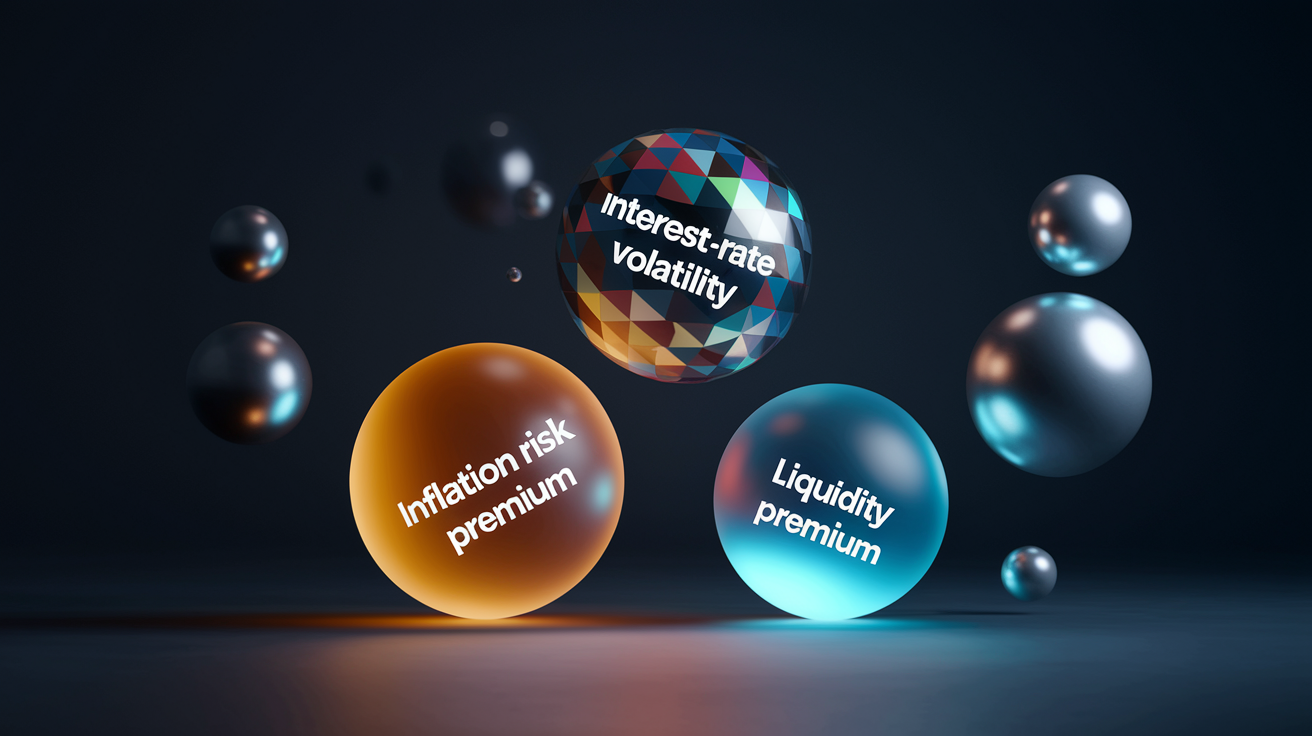
The term premium bundles several distinct risk premia, each responding to different market conditions. Inflation risk premium pays you for uncertainty about future price levels. In calm periods with well-anchored expectations, this might add only 10 to 30 basis points to the term premium. When inflation surprises hit, central bank credibility cracks, or commodity shocks land, that component can double or triple.
Interest rate volatility premium reflects the risk that yields swing unpredictably, generating capital losses. Higher realized or implied volatility, measured by indicators like the MOVE index, pushes this component higher. Empirical ranges suggest 20 to 80 basis points in normal times, with spikes during acute uncertainty like policy-rate tightening cycles or geopolitical shocks. Investors holding long-duration bonds face larger mark-to-market moves when rate volatility rises, so they demand extra yield to bear that exposure.
Liquidity and convenience premia capture the value investors place on safe, easily tradable assets. U.S. Treasuries serve as collateral in repo markets, satisfy regulatory liquidity buffers, and act as portfolio hedges during risk-off episodes. Strong demand for these features can compress the term premium, even turning it negative, by 10 to 100 basis points or more in stress periods. Conversely, reduced central bank purchases, higher fiscal issuance, or regulatory changes that lower mandated Treasury holdings can reduce this convenience value and lift the term premium.
Typical basis point ranges by component in stable conditions:
Inflation risk premium: 10 to 30 bps
Interest rate volatility premium: 20 to 80 bps
Liquidity or convenience premium: 10 to 100+ bps (variable by regime)
Residual uncertainty (policy path, fiscal): 10 to 40 bps
These components move independently. A flight to quality can push liquidity premium down while inflation fears push inflation risk premium up, leaving the net term premium relatively stable but with altered internal composition.
Market Forces That Move the Term Premium Over Time

The term premium isn’t static. It shifts with macro conditions, policy regimes, and investor positioning. Historical data show premiums rose sharply in the high-inflation 1970s and early 1980s, then declined steadily through the 1990s and 2000s as inflation stabilized and central banks gained credibility. During parts of the 2010s, term premiums on 10-year Treasuries turned negative, with estimates ranging from roughly −50 to −100 basis points, driven by aggressive quantitative easing and strong global demand for safe assets.
Monetary policy exerts direct pressure on the term premium through balance sheet operations. Quantitative easing, large-scale central bank purchases of long-dated bonds, removes duration from private hands and lowers the yield investors require. Empirical estimates suggest cumulative QE announcements in the 2010s reduced the 10-year term premium by about 110 basis points on announcement days. Quantitative tightening or balance sheet runoff adds duration back into the market, raising the term premium. Forward guidance that reduces uncertainty about the future policy path can also compress the premium by lowering interest rate volatility.
Supply and demand dynamics play an equally important role. Fiscal deficits increase Treasury issuance, forcing the market to absorb more duration and typically pushing term premiums higher. The “global saving glut” of the mid-2000s, strong foreign reserve accumulation and persistent current account surpluses, channeled demand into Treasuries and kept premiums low. Regulatory changes since the financial crisis, such as bank liquidity coverage ratios and clearing-house collateral rules, have increased structural demand for high-quality liquid assets, applying downward pressure on term premiums even as fiscal supply has grown.
Historical Ranges and Regime Shifts
After 2021, term premium estimates shifted decisively positive, with many models reporting values in the range of +50 to +150 basis points by 2023 and 2024. The move reflected several forces: the Federal Reserve’s pivot from QE to quantitative tightening, a surge in fiscal issuance to fund pandemic-related programs and infrastructure spending, rising inflation that eroded central bank credibility, and heightened geopolitical uncertainty. The so-called “Treasury tantrum” of mid-2023 saw 10-year yields jump from around 3.35% in May to 4.99% in October, with much of the move attributed to a rising term premium rather than a shift in expected short rates.
Investors use these regime shifts as signals for portfolio construction. A sustained rise in the term premium suggests long-duration bonds offer better compensation for rate risk, potentially justifying a barbell or laddering strategy that captures higher yields at longer maturities. A return to negative or very low premiums would favor short-duration positioning and floating-rate instruments, or tactical curve trades that profit from steepening or flattening moves.
Numeric Examples: Holding Long Bonds Versus Rolling Short-Term Instruments

Consider choosing between buying a 10-year Treasury at a yield of 3.50% or rolling a 1-year Treasury at 1.50% each year for ten years. If you hold the 10-year bond to maturity, the annualized yield is 3.50%, producing a total return of (1.035)^10 − 1, roughly 41.1% over the decade. If you roll the 1-year bond and the rate stays at 1.50%, the total return is (1.015)^10 − 1, about 16.1%. The difference, around 25 percentage points, reflects both the term premium and any expected rise in short rates embedded in the 10-year yield. This gap is the excess return the market offers to investors willing to lock in duration.
Price sensitivity to rate changes amplifies the importance of the term premium. A 10-year Treasury has a modified duration of about 8 to 9 years, meaning a 100 basis point increase in yields causes a price decline of roughly 8 to 9 percent. If the term premium compresses by 100 bps while expected short rates stay stable, the bond price rises by a similar magnitude, delivering a capital gain. A sudden jump in the term premium, as happened in the 2023 Treasury tantrum, can erase months of coupon income in a matter of weeks. Investors holding long maturities must weigh the extra yield against the potential for sharp mark-to-market losses when the premium expands.
| Scenario | Total Return or Price Impact |
|---|---|
| Hold 10y at 3.5% to maturity | Approx. +41.1% total return over 10 years |
| Roll 1y at 1.5% for 10 years | Approx. +16.1% total return over 10 years |
| 100 bps yield rise (duration ≈8–9) | Approx. −8% to −9% price decline |
The risk-return trade-off hinges on the term premium. When the premium is elevated, you get meaningful compensation for duration risk, making long bonds attractive if you believe the premium will stay stable or compress. When the premium is low or negative, the incremental yield offers little buffer against rate volatility, and rolling short-term instruments or using floating-rate securities may deliver better risk-adjusted returns.
Portfolio Strategy and Term Premium Signals for Bond Investors

When the term premium climbs above roughly 75 to 100 basis points, long-duration exposure becomes more attractive because you earn a substantial yield cushion for bearing interest rate risk. This regime favors buying 10-year or 30-year Treasuries outright, extending portfolio duration, or implementing roll-down strategies that capture the decline in yield as bonds age. A high term premium also supports curve-steepening trades, where you position for a widening gap between short and long rates, often by going long the back end and short the front end.
When the term premium is low or negative, short-duration and floating-rate instruments typically outperform. A compressed premium signals strong demand for long-dated bonds, low expected volatility, or central bank intervention that suppresses yields. In this environment, you face limited compensation for locking in duration, and the risk of a sudden repricing, driven by inflation surprises, fiscal shocks, or policy shifts, is high relative to the incremental yield. Tactical allocations might favor 2-year to 5-year maturities, Treasury bills, or floating-rate notes that reset with policy rates, protecting capital if the term premium expands.
Curve trades offer another layer of strategy. If you expect the term premium to rise due to fiscal expansion or quantitative tightening, a flattener trade, betting that long rates rise relative to short rates, can capture that move. If the premium is expected to compress because of renewed QE or a flight to quality, a steepener trade profits from long rates falling more than short rates. Hedging becomes critical when the term premium is volatile: options on Treasury futures, interest rate caps, or duration-neutral trades (such as barbell vs. bullet structures) allow you to manage exposure without abandoning yield entirely.
Tactical steps for using term premium in portfolio decisions:
Evaluate the current term premium level using multiple estimates (model-based and survey-based) to confirm the signal.
Assess the expected path of short rates from forward curves, central bank guidance, and macro forecasts.
Choose duration exposure: extend when premium is elevated, shorten when premium is low or negative.
Select hedges or curve positions to protect against adverse premium shifts, balancing yield pick-up with downside risk.
Monitoring the Term Premium: Tools, Indicators, and Practical Techniques

Investors track the term premium using a combination of yield curve data, forward rate calculations, and published model estimates. The simplest proxy is to subtract the average forward short rate from the observed long yield. For example, calculate the 1-year forward rates implied by the Treasury curve for each year over the next decade, average them, and subtract that average from the current 10-year yield. The residual is your estimate of the term premium. This method is transparent and can be updated daily, though it relies on the assumption that forward rates reflect true market expectations rather than liquidity or technical factors.
Model-based estimates provide a second layer. The Adrian-Crump-Moench (ACM) model published by the New York Fed and the Christensen-Rudebusch (CR) model from the San Francisco Fed use statistical term-structure frameworks to decompose yields into expected short rates and risk premia. These models often show divergence, sometimes 50 to 100 basis points, because they make different assumptions about the expected fed funds path. Survey-based approaches, such as the Survey of Primary Dealers or the Livingston Survey, ask market participants or professional forecasters to project future short rates, offering a cross-check that doesn’t depend on statistical assumptions. Investors benefit from monitoring multiple sources and focusing on directional agreement rather than absolute levels.
Steps to estimate and monitor the term premium in practice:
Extract forward rates from the current Treasury curve and compute the average expected short rate over the relevant horizon.
Track realized and expected inflation using CPI prints, breakeven rates from TIPS, and survey measures of long-run inflation expectations.
Monitor central bank policy expectations through dot plots, forward guidance, and fed funds futures to refine short-rate projections.
Watch volatility signals such as the MOVE index (interest rate volatility) and option skew, which indicate how much premium the market demands for uncertainty.
Assess liquidity spreads, repo rates, and safe-asset demand proxies to gauge the convenience premium component of the term premium.
Investors typically refresh these estimates weekly or monthly, increasing frequency around key macro events such as FOMC meetings, inflation releases, or fiscal announcements. A rising term premium combined with stable or falling expected short rates suggests duration is becoming more attractive. A falling premium with rising short-rate expectations points to a flattening curve and potential pressure on long-bond returns.
Final Words
In the action, we defined the term premium as the extra annual yield investors demand to hold long bonds and gave a clear numeric example: a 10‑year at 3.5% versus expected 1‑year averages of 2.0% implies about 150 bps.
We then broke yields into expected short rates plus the premium, unpacked drivers like inflation uncertainty, volatility, and liquidity, and showed how that math changes total return and price sensitivity.
Now what: monitor the forward curve, volatility (MOVE), and issuance to set duration and curve trades. This is term premium explained for bond investors as a practical tool — use it to tilt risk and capture income when the setup favors longer duration.
FAQ
Q: What does the term premium mean in bonds?
A: The term premium in bonds is the extra annual yield investors demand to hold a long‑maturity bond instead of rolling short‑term securities. Example: 10‑year yield 3.5% minus expected 1‑year average 2.0% = 1.5% (150 bps).
Q: How to calculate term premium on bonds?
A: The term premium on bonds is calculated by subtracting the average expected short‑rate path from the long‑term yield. E.g., 3.5% 10‑year yield minus 2.0% expected average = 1.5% term premium.
Q: Why would an investor pay a premium for a bond?
A: An investor pays a premium for a bond to lock higher coupon income or secure safer cash flows when expected rates fall, or to gain desired duration exposure or tax advantages.
Q: How often do you win with 10,000 Premium Bonds?
A: With 10,000 Premium Bonds, the win rate equals 10,000 times the annual win probability per bond; at odds of 24,500 to 1 that’s about 0.4 wins per year (≈1 every 2–3 years).