


What if one monthly jobs number decides whether the Fed keeps rates high or starts cutting?
Payrolls matter because they touch both the Fed’s goals: jobs and 2 percent inflation.
Think of payrolls as the Fed’s thermometer.
Hiring, unemployment, and wage trends tell policymakers how hot the economy really is.
Strong payrolls push rates up or keep policy restrictive.
Weak payrolls make cuts more likely.
This piece explains how the data moves the Fed, which signals to watch, and the scenarios that should change your trade or portfolio.
How Payroll Data Shapes Federal Reserve Policy Decisions

The Federal Reserve works with two main jobs: keep people employed and keep inflation around 2 percent. Payroll data touches both. When hiring picks up and unemployment drops, the economy usually adds demand faster. That puts pressure on wages, and eventually consumer prices creep higher. The Fed has to decide if its current policy is tight enough to stop things from overheating. On the flip side, when payrolls weaken and unemployment climbs, the Fed has to figure out whether it’s squeezing too hard and risking unnecessary slack. Every monthly employment report gives the Fed a fresh look at how close we are to “maximum employment” and whether that’s about to push inflation past the 2 percent line.
Job growth, unemployment, and wage trends all feed into how the Fed thinks about inflation risk. Strong monthly gains, anything above 250,000, usually mean employers are fighting for workers and bidding up wages. Wage growth running above roughly 3.5 to 4.0 percent year over year tends to show up in services inflation, since labor is the biggest cost for most service businesses. When unemployment falls below historical averages near 4 percent, it suggests there’s not much slack left. Any extra stimulus at that point is more likely to raise prices than put idle workers back to work. The Fed weighs all of this against the 2 percent target. Persistent strength across payrolls, low unemployment, and rising wages usually means rates need to stay elevated or go higher.
Strong payrolls typically mean the Fed keeps hiking or at least stays put at restrictive levels for a while. When job gains consistently beat forecasts and unemployment sits near multi-decade lows, policymakers see that as proof the economy can handle higher borrowing costs without sliding into recession. Weak payrolls, monthly gains below 100,000 or outright declines, change the math. If job creation stalls but inflation stays high, the Fed has a harder choice. But if inflation is cooling too, weak employment data cracks the door open for rate cuts. The direction depends on the mix: strong labor plus high inflation means tighten, weak labor plus falling inflation means ease. Strong labor with falling inflation or weak labor with high inflation creates tension, and the Fed has to pick which side of the mandate matters more right now.
The Fed tracks four main pieces of the monthly employment report:
- Nonfarm payrolls: the headline number showing net new jobs added or lost across most industries.
- Unemployment rate: the share of the labor force looking for work but not employed, a direct read on slack.
- Labor force participation rate: the percentage of working-age people either working or looking for work, showing how many potential workers are actually engaged.
- Average hourly earnings: monthly and year over year wage growth, the clearest real time signal of wage driven inflation pressure.
Key Payroll Metrics the Fed Watches Closely

Nonfarm payrolls measure the net change in employment across nearly all U.S. industries, minus farm workers, private household employees, and a few other groups. The Bureau of Labor Statistics releases the figure monthly. It shows how many jobs the economy added or lost over the prior month. A typical healthy expansion sees monthly gains between 150,000 and 250,000, enough to absorb new workers entering the labor force and gradually push unemployment lower. When payrolls consistently top 250,000, the Fed reads that as strong aggregate demand. Households and businesses feel confident enough to hire aggressively. Drops below 100,000 or negative prints signal cooling demand and raise the risk that the labor market is losing steam. The Fed doesn’t just look at the headline number. It also watches the three month moving average to smooth out volatility and spot the underlying trend.
The unemployment rate shows the percentage of people in the labor force who are jobless and actively looking for work. It’s the most visible snapshot of labor market slack. When unemployment falls below historical norms, roughly 4 percent in recent cycles, the Fed worries that more fiscal or monetary stimulus will just drive up wages and prices instead of putting more people to work. A rising unemployment rate, especially a jump of 0.2 percentage points or more in a single month, signals the economy might be cooling faster than expected. Policymakers pay attention to the speed and size of changes. A gradual drift higher might fit with a soft landing. A sharp jump often comes before recessions and pushes the Fed to ease policy to prevent a spiral of layoffs and falling demand.
Labor force participation measures how many working age adults are either employed or looking for work, as a percentage of the civilian non-institutional population. Participation can fall for structural reasons like aging demographics, early retirements, or more people in school. Or it can fall for cyclical reasons, like discouraged workers dropping out during a downturn. The Fed cares because participation affects the “breakeven” rate of job growth needed to hold unemployment steady. If participation is rising, the economy has to add more jobs each month just to keep the unemployment rate from climbing. If participation is falling, even modest job gains can push unemployment lower. A declining participation rate during weak payrolls can hide underlying labor market weakness, making the unemployment rate look artificially stable. Rising participation during strong job growth can keep the unemployment rate from falling too fast, giving the economy more room before hitting capacity limits.
Wage growth, tracked mainly through average hourly earnings, shows how much bargaining power workers have and how quickly labor costs are rising. The Fed watches both the month over month change and the year over year rate. Wage growth consistently above 4 percent year over year usually signals tight labor conditions and feeds into services inflation, which makes up most of the consumer price index. Slowing wage growth, especially a drop toward 3 percent or below, suggests the labor market is loosening and wage driven inflation pressures are easing. Wages adjust more slowly than other prices, so sustained wage acceleration is a lagging but powerful sign that inflation might prove stickier than hoped. The Fed often brings up wage trends in public remarks to explain why it’s keeping rates higher or why it can afford to ease once wage growth normalizes.
The Fed’s Current Policy Stance in Light of Recent Payroll Trends

Recent payroll data has shown a sharp slowdown in job creation. Monthly gains averaged near 35,000 over a three month window, and two of the past three months posted negative readings after revisions. At the same time, the unemployment rate has ticked up modestly and labor force participation has declined, falling from 62.5 percent a year earlier to 62.0 percent. Despite these signs of cooling, initial jobless claims have stayed low and wage growth, while slowing, still runs near 3.8 percent year over year. That’s faster than the roughly 3 percent pace the Fed thinks is consistent with 2 percent inflation over the long run.
Senior Fed officials have called the labor market “broadly in balance” and consistent with the Fed’s maximum employment mandate, even after the weaker February report. That language tells us policymakers aren’t yet alarmed by the payroll slowdown. The Fed’s public tone has stayed cautious rather than dovish. Officials stress they’re watching the data closely but see no immediate need to shift from the current stance. After three rate cuts last year, the federal funds target range sits around 5.25 to 5.50 percent, and the committee has signaled a data dependent approach to any further moves.
The mix of weaker job creation and still firm wage gains creates a policy tension. If payrolls keep softening while wage growth slows further, the Fed will likely read that as proof the labor market is normalizing and inflation pressures are easing. That opens the door to more cuts. But if the recent weakness in payrolls reflects a drop in the breakeven job growth rate, driven by falling labor force participation and a sharp slowdown in working age population growth due to reduced immigration, then current job gains may already be close to “neutral.” Neither adding nor subtracting from labor market slack. In that case, more easing risks rekindling wage and price pressures. The Fed’s near term path will depend on whether the next several months of data confirm a real cooling in labor demand or show that the breakeven rate itself has shifted lower.
Historical Examples of Payrolls Shifting Fed Policy
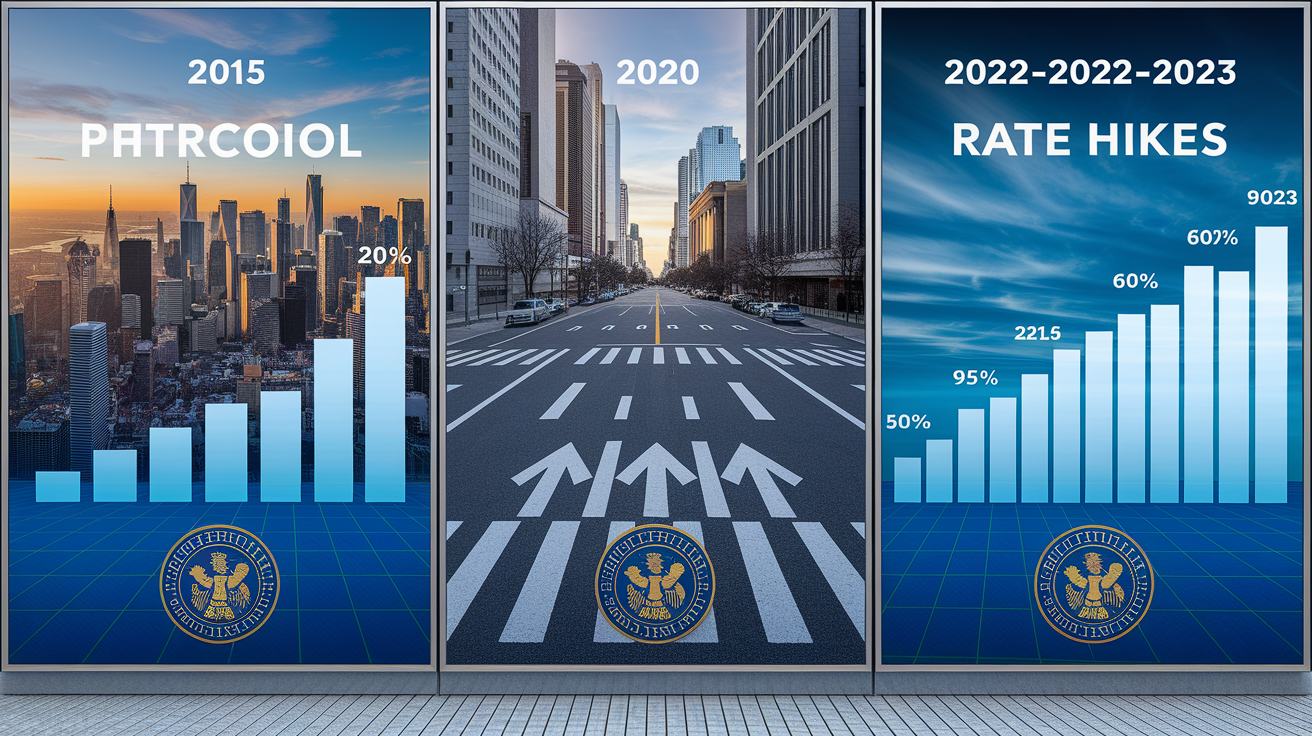
During the mid 2010s, the Fed started its first post financial crisis tightening cycle against a backdrop of steadily improving payrolls. Monthly job gains averaged well above 200,000, the unemployment rate fell below 5 percent for the first time since 2008, and wage growth began to tick up. By late 2015, the Federal Open Market Committee decided that the labor market had reached or exceeded maximum employment, and it delivered the first rate hike in nearly a decade. Over the next three years, continued strong payrolls, often topping 250,000 per month, supported a gradual hiking cycle that lifted the federal funds rate from near zero to a range of 2.25 to 2.50 percent by late 2018. Policymakers explicitly pointed to robust job creation and falling unemployment as proof the economy could handle higher borrowing costs without stalling. The labor data gave the green light for tightening even as inflation stayed subdued, because the Fed expected that a tight labor market would eventually create price pressures.
The COVID-19 pandemic triggered the most dramatic payroll shock in modern U.S. history. In April 2020, nonfarm payrolls dropped by roughly 20.5 million jobs as lockdowns shut down businesses nationwide and the unemployment rate spiked above 14 percent. The Fed responded with emergency actions. It slashed the federal funds rate to near zero in two unscheduled inter-meeting cuts and launched large scale asset purchases to support credit markets and the broader economy. The scale and speed of the response were driven directly by the employment collapse. As job losses mounted, the Fed knew that without aggressive easing, the downturn would deepen and the labor market would take years to recover. Over the following months, as payrolls rebounded, initially at rates of several million per month, the Fed kept its accommodative stance. It emphasized that it wouldn’t tighten until the labor market had made “substantial further progress” toward maximum employment. The employment collapse and recovery became the main story guiding policy through 2020 and into 2021.
From 2021 through early 2023, the U.S. labor market came back with unexpected strength. Monthly payroll gains consistently topped 400,000, unemployment fell below 4 percent, and wage growth surged above 5 percent year over year at its peak. The mix of strong job creation, a historically tight labor market, and accelerating wages coincided with the highest inflation readings in four decades. The Fed pivoted hard, raising rates at the fastest pace since the early 1980s. Seven consecutive 75 basis point hikes over 2022. Policymakers repeatedly pointed to labor market strength as a key reason the economy could withstand aggressive tightening without tipping into recession. The persistence of robust payrolls gave the Fed confidence that raising borrowing costs would cool demand and slow inflation without triggering mass layoffs. This stretch showed how sustained strong employment data can not only justify but speed up a tightening cycle when inflation is running well above target.
How Markets React to Payroll Reports and Fed Interpretation

Payroll reports are among the most closely watched economic releases. They arrive monthly and offer a real time snapshot of labor demand, a variable that directly influences Federal Reserve policy. Markets treat the first Friday of each month, when the Bureau of Labor Statistics publishes the employment situation, as a major event risk. Traders know that a big surprise in nonfarm payrolls, the unemployment rate, or wage growth can immediately shift expectations for the federal funds rate path over the next several quarters. Interest rates are the primary tool the Fed uses to manage the economy, so any new information that changes the perceived odds of hikes, pauses, or cuts ripples through asset prices within seconds of the 8:30 a.m. ET release.
Strong payroll data, monthly gains well above consensus or an unexpected drop in unemployment, typically makes traders reprice the odds of tighter or longer lasting restrictive policy. If the Fed was expected to cut rates soon, a hot jobs report can push that timeline out by months and reduce the expected number of cuts over the year. That shift sends Treasury yields higher, especially at the short end where two year notes are most sensitive to near term policy expectations. Equity markets often sell off on strong payrolls when inflation is still elevated. Higher for longer rates increase discount rates and compress valuations, particularly for growth stocks. Weak payroll data, monthly gains far below forecast or a jump in unemployment, raises the probability of imminent rate cuts. That expectation pulls Treasury yields lower, lifts bond prices, and can boost equities if investors believe the Fed will ease before a recession takes hold. The size of the market move depends on how far the data deviates from consensus and how it lines up with recent Fed communication.
The following asset types commonly react to payroll surprises and shifts in Fed policy expectations:
- Treasury yields: Short term yields, especially 2 year, move sharply as traders reprice the expected path of the federal funds rate. 10 year yields also adjust but are influenced by longer term growth and inflation expectations.
- Equities: Stock indexes can rally on weak payrolls if the data signals rate cuts are coming, or sell off on strong payrolls if it implies sustained high rates. Sector rotation often follows, with rate sensitive sectors like utilities and real estate moving inversely to yields.
- U.S. dollar: A stronger payroll report tends to lift the dollar against other currencies as higher U.S. rates attract capital flows. Weaker data can pressure the dollar if markets expect the Fed to cut while other central banks hold steady.
- Fed funds futures: These derivatives directly price the probability of rate changes at upcoming FOMC meetings. A payroll surprise can shift the implied odds of a 25 basis point move by tens of percentage points within minutes.
- Corporate bonds: Credit spreads can widen on weak payrolls if recession fears rise, or tighten on strong data if it suggests economic resilience. Investment grade and high yield bonds both respond to the interplay of default risk and interest rate expectations.
Final Words
in the action: payroll releases drive the Fed’s labor read, covering job gains, unemployment, and wages, and they feed into the dual mandate. Strong payrolls push inflation risk higher; weak payrolls ease that pressure.
Near term, watch nonfarm payrolls, the unemployment rate, participation, and wage growth. Markets rebalance odds for hikes or cuts after each print.
For a quick takeaway on what payrolls report means for fed policy: each report nudges the probabilities for tighter or looser policy, not decides them. Stay focused on the four metrics and you’ll be ready to act.
FAQ
Q: Did the US lose 33,000 jobs in June?
A: Whether the US lost 33,000 jobs in June depends on the source; the definitive number comes from the Bureau of Labor Statistics’ monthly nonfarm payrolls report, so check that release for the exact June figure.
Q: What do nonfarm payrolls indicate?
A: Nonfarm payrolls indicate the monthly change in payroll employment excluding farm workers; they show job creation, signal labor-market strength and inflation pressure, and feed directly into Federal Reserve decisions.
Q: Why were 92,000 jobs lost?
A: A 92,000-job loss usually reflects industry-specific cuts, seasonal effects, survey revisions, or temporary shocks; the BLS breakdown identifies which sectors and adjustments produced the decline.
Q: What is the US payroll report?
A: The US payroll report is the monthly BLS release that lists nonfarm payrolls, the unemployment rate, participation rate and wage growth, used to assess labor-market health and guide Federal Reserve policy.